Enterprise Prompt Architecture: Governance and Design

Enterprise Prompt Architecture: From Prompt Collections to Governed Assets

Enterprise prompt architecture is the governed structure used to design, parameterize, test, version, approve, deploy, and maintain prompts as components of business workflows.

Executive Summary

Prompt libraries frequently start as a personal convenience – someone finds a phrasing that works well and saves it – and grow, unmanaged, into unstructured collections with unclear owners, hidden dependencies on assumptions about a specific model version, embedded confidential data that shouldn’t have been pasted in, inconsistent variables, and no actual evidence that the prompt performs reliably in the workflow it’s meant to serve. A prompt becomes an enterprise asset only when its purpose, inputs, variables, sources, output contract, tests, owner, version, and use restrictions are made explicit – the same governance discipline organizations already apply to code, just rarely applied to prompts. This guide covers the anatomy of a production-ready prompt, the registry and taxonomy needed to manage prompts at scale, the full prompt lifecycle from proposal to retirement, and how to manage the risk that a prompt’s performance can shift without warning when the underlying model changes.

Key Takeaways:

  • Personal prompt libraries – informal collections with no owner, version control, or testing – don’t scale reliably beyond individual use.
  • A production prompt has an explicit component model: purpose, role, context, instructions, variables, sources, constraints, output schema, and more.
  • Prompts need a full lifecycle – propose, design, test, review, approve, publish, monitor, revise, retire – not a one-time creation event.
  • Confidentiality and prompt-injection risks need explicit management, since prompts routinely handle sensitive context and untrusted input together.
  • Model and vendor changes can silently degrade a previously reliable prompt, which is why change management is part of the architecture, not an afterthought.

What Is Enterprise Prompt Architecture?

Enterprise prompt architecture treats a prompt the way software engineering treats a reusable code component: something with a defined purpose, explicit inputs and outputs, a testing regime, a version history, an accountable owner, and a controlled process for changing it. This is a deliberate shift away from treating a prompt as a personal snippet saved in a notes app or chat history – a shift that becomes necessary the moment more than one person, or more than one workflow, depends on that prompt performing consistently.

The comparison to software engineering is deliberate rather than decorative. Organizations that would never accept a critical piece of business logic living only in one engineer’s personal notes, undocumented and untested, routinely accept exactly that arrangement for prompts that drive customer-facing content, campaign messaging, or client deliverables. The reason is often simply that prompts look like plain language rather than code, which makes them feel less like infrastructure that needs governance – but a prompt that determines what a workflow produces is functionally playing the same role a configuration file or a business rule would play in a traditional system, and it warrants the same operational rigor once it’s relied upon by more than its original author.

Why Personal Prompt Libraries Do Not Scale

A personal prompt library works fine for exactly one thing: the person who wrote it, working from memory of why it works, using the model they tested it against. The moment a second person tries to reuse it, or the underlying model changes, or the prompt needs to handle a slightly different case, the informal library shows its limits – there’s no record of what the prompt was actually designed to do, no test confirming it still works, no owner to ask when it produces an unexpected result, and often no awareness that the prompt contains an embedded assumption (a specific data format, a specific model’s behavior) that no longer holds. What worked for one person’s individual productivity does not automatically work as shared organizational infrastructure.

Anatomy of a Production Prompt

kōdōkalabs - intelligence hub - AI Marketing Operating Systems - Enterprise Prompt Architecture - Modular Prompt Architecture
AI Marketing Operating Systems - Enterprise Prompt Architecture - Modular Prompt Architecture
kōdōkalabs’ Prompt Component Model defines the parts a production-ready prompt should specify explicitly.
Component
Purpose

Purpose

What business task this prompt performs
The perspective or persona the prompt establishes for the model
What background information the prompt provides
The specific task directions
What changes between uses of the prompt
What knowledge or data the prompt draws on
What the prompt explicitly restricts or prohibits
The required structure of the response
Sample inputs and outputs illustrating correct behavior
How output quality is judged
What the prompt should do when it can’t complete the task properly

Metadata

Owner, version, and other registry information
A prompt missing several of these components can still produce a good result occasionally – but “occasionally” is the problem. Enterprise use requires reliability across many uses by potentially many people, which is exactly what an unspecified prompt can’t guarantee.

Variables, Context, Knowledge, and Output Contracts

Variables are what make a prompt reusable rather than a one-off – clearly defined placeholders for what changes between uses, distinct from the fixed instructions around them. Context and knowledge references should point to the organization’s governed knowledge base (see AI Marketing Knowledge Base) rather than being pasted in ad hoc each time, so the prompt draws on current, authoritative information rather than a snapshot that goes stale. The output contract – a defined schema for what the response should look like – is what makes a prompt’s output usable by downstream systems or reviewers without manual reformatting every time.

System Instructions vs. Task Prompts vs. Reusable Modules

Enterprise prompt architecture distinguishes three layers, each with a different scope and change frequency.

Layer
Scope
Typical Change Frequency

System instructions

Broad behavioral rules applying across many prompts (tone, safety boundaries, formatting defaults)
Infrequent

Task prompts

Specific instructions for one defined task
Moderate

Reusable modules

Shared components (a source-citation format, a brand-voice reminder) inserted into multiple task prompts
Infrequent, but changes propagate widely
Treating all three as one undifferentiated block of text makes maintenance harder – a change intended to affect only one task prompt can accidentally alter system-wide behavior if the layers aren’t separated, and a genuinely system-wide change (a new safety requirement, for instance) has to be manually copied into every individual prompt if reusable modules aren’t used.

Prompt Registry and Taxonomy

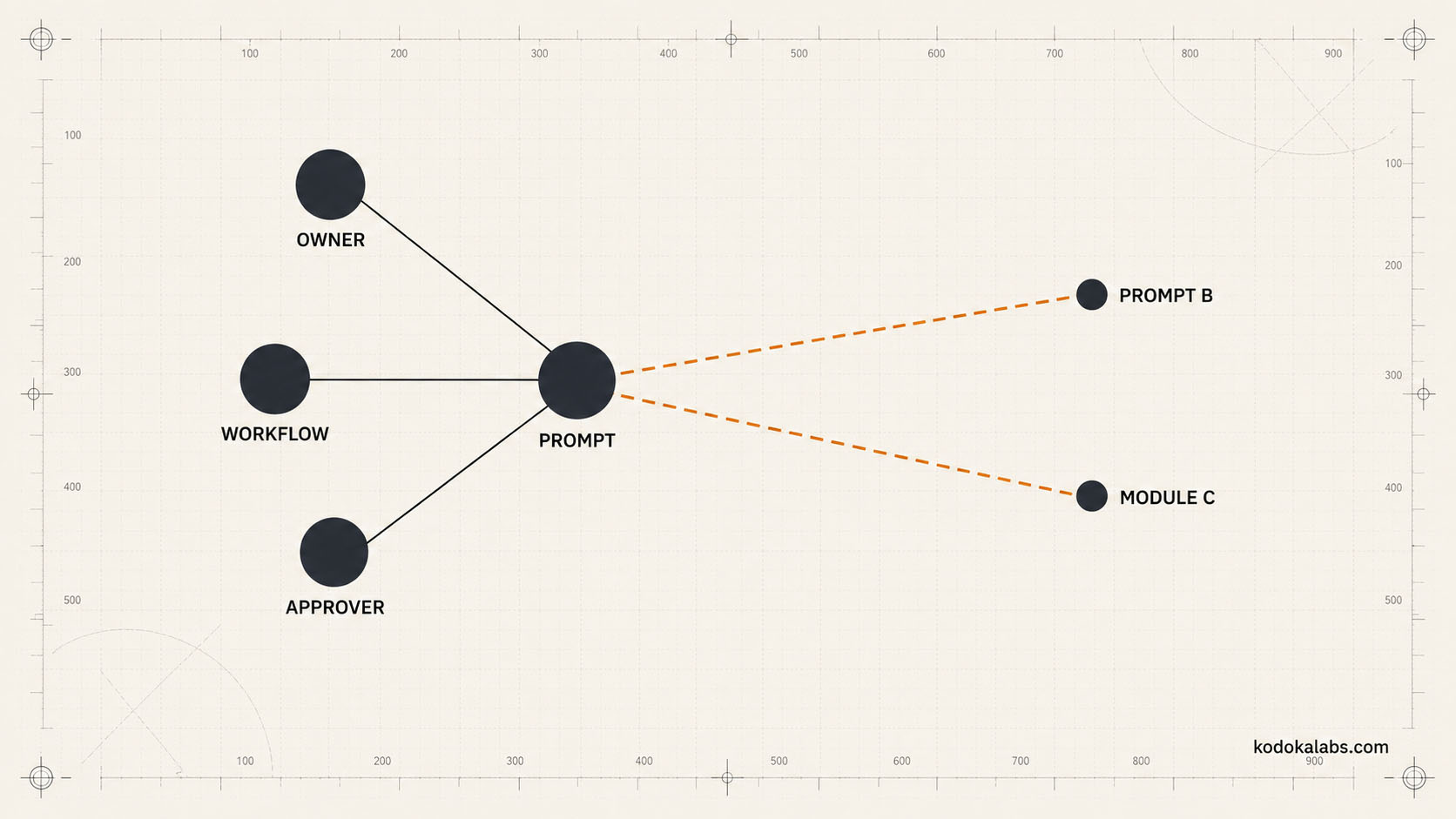
kōdōkalabs - intelligence hub - AI Marketing Operating Systems - Enterprise Prompt Architecture - Prompt Registry Relationships
Enterprise Prompt Architecture - Prompt Registry Relationships
kōdōkalabs’ Prompt Registry tracks every production prompt with structured fields, making prompts discoverable, auditable, and manageable at scale.
Registry Field
Purpose

Unique ID

Unambiguous reference

Title

Human-readable identification

Owner

Accountable individual

Workflow

Which business workflow this prompt serves

Audience

Who uses this prompt or consumes its output

System/model compatibility

Which AI systems this prompt has been tested against

Data class

What sensitivity level of data this prompt is approved to handle

Dependencies

Other prompts, modules, or knowledge sources this prompt relies on

Version

Current revision number

Status

Active, in review, deprecated

Test set

The scenarios used to validate this prompt

Evaluation result

Outcome of the most recent test

Approver

Who signed off on the current version

Change history

Record of prior versions and what changed

Retirement rule

Conditions under which this prompt should be retired
Without a registry, an organization typically doesn’t know how many prompts it actually has in production, which ones are duplicates of each other with slightly different wording, or which ones haven’t been reviewed since a model change that may have affected their performance.

Prompt Lifecycle and Version Control

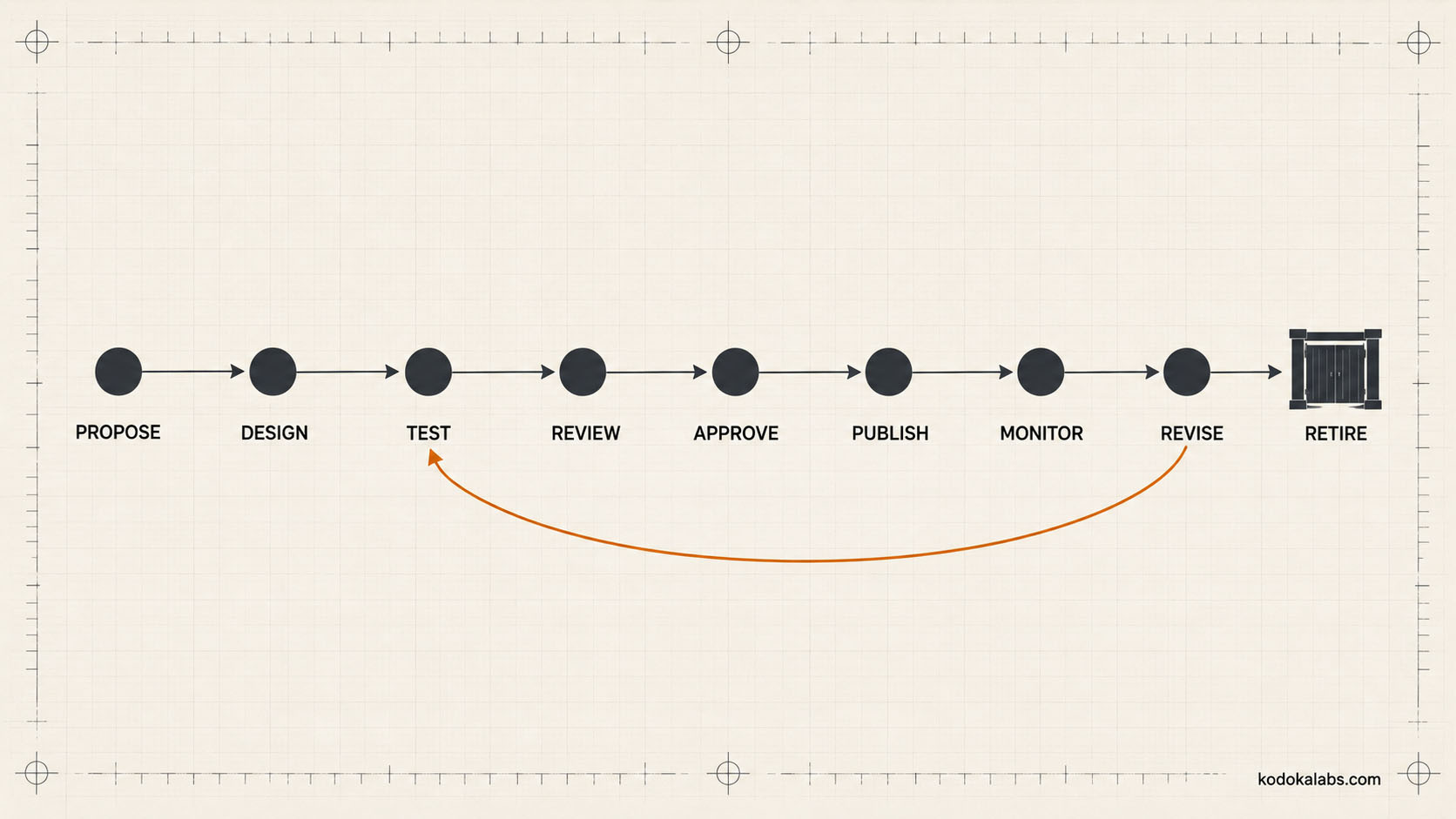
kōdōkalabs - intelligence hub - AI Marketing Operating Systems - Enterprise Prompt Architecture - Prompt Lifecycle and Version Control
Enterprise Prompt Architecture - Prompt Lifecycle and Version Control
kōdōkalabs’ Prompt Lifecycle moves a prompt through nine stages: propose, design, test, review, approve, publish, monitor, revise, retire. Each transition should be a deliberate decision, not an informal edit made directly to a prompt already in production use. Version control – keeping a record of every prior version and what changed between them – is what makes it possible to roll back a change that turns out to degrade performance, and to understand what was different about a prompt at the time it produced a specific piece of output under review.

Testing and Evaluation

A prompt should be tested against a defined set of representative scenarios before publication – including edge cases, not only the clean example that inspired the prompt in the first place – and re-tested whenever the underlying model changes or the prompt itself is revised. Evaluation criteria should be specific enough that two different reviewers would reach the same conclusion about whether a given test result passed or failed, rather than relying on a vague sense that the output “looks right.”

Model and Vendor Change Management

A prompt that performs reliably against one model version is not guaranteed to perform identically after that model is updated, retired, or replaced with a different vendor’s system – model providers routinely change underlying behavior in ways that aren’t always fully documented, and a prompt tuned to specific quirks of one model’s behavior can degrade quietly when those quirks change. Enterprise prompt architecture treats model and vendor changes as triggering events that require re-testing affected prompts, not as background infrastructure updates that don’t touch the content layer.

This is one of the more counterintuitive parts of prompt governance for teams used to traditional software, where an infrastructure upgrade – a server migration, a library update – is typically invisible to the application layer if done correctly. Model updates don’t work that way. Because a prompt’s reliability depends partly on the specific behavioral quirks of the model it was tuned against, an update billed by the vendor as an improvement can change how that particular prompt performs, in either direction, without any change having been made to the prompt itself. This is why the registry’s system/model compatibility field and test set aren’t optional metadata – they’re what makes it possible to know, after a vendor announces a model update, exactly which prompts need re-validation before anyone can trust their continued reliability. Any advice about how to structure a prompt for a specific model should be dated and clearly scoped to that model and version – a technique that works well for one system at one point in time is not guaranteed to transfer to another system, or even to a later version of the same one.

Data, Confidentiality, and Injection Risks

Prompts routinely combine trusted instructions with untrusted input – customer messages, scraped content, documents from external parties – and this combination creates specific risks worth designing against explicitly. Confidential data should never be embedded directly in a shared prompt template where it might be exposed to unintended audiences; instead, sensitive context should be injected at runtime through controlled, access-restricted mechanisms. Prompt injection – where untrusted input contains text designed to override or manipulate the prompt’s actual instructions – should be anticipated by treating all externally sourced content as data to be processed, not as instructions to be followed, consistent with the same principle described on the Agentic Drafting methodology page.

Roles and Approval Rights

Different roles hold different rights within prompt architecture: prompt authors design and propose; technical reviewers assess feasibility and risk; subject-matter reviewers assess accuracy and appropriateness for the domain; a registry owner maintains the overall system; and a final approver signs off before a prompt moves to production status. Concentrating all of these rights in one person, particularly for prompts touching sensitive data or high-visibility output, tends to produce the same single-point-of-failure risk any other unreviewed process creates.

Distribution, Access, and Reuse

Approved prompts should be distributed through the registry, not through informal sharing – copying a prompt into a chat message or a shared document creates an untracked fork that won’t receive updates when the canonical version changes. Access to prompts handling sensitive data classes should be restricted to appropriately authorized users, consistent with the data class recorded in the registry. Reuse across teams is one of the main benefits of a governed architecture, but only when reused prompts stay connected to their canonical, maintained version rather than being copied and then drifting independently.

Measuring Prompt Performance

Prompt performance should be tracked over time, not assumed constant from the moment it passes initial testing – output quality against evaluation criteria, failure rate, how often human reviewers need to significantly correct the output, and any drift in performance following a model update. A prompt that performed excellently at launch and hasn’t been checked since is an unverified assumption, not a confirmed asset.

Retirement and Consolidation

Prompts should be retired when they’re superseded by an improved version, when the workflow they served no longer exists, or when testing reveals they no longer perform reliably against a current model. Registries also tend to accumulate near-duplicate prompts over time – several slightly different versions of essentially the same task prompt, created by different people who didn’t know an existing one already served their need. Periodic consolidation, comparing similar prompts and retiring redundant ones in favor of a single maintained version, keeps the registry usable rather than becoming its own source of confusion.

Duplication tends to accumulate for a predictable reason: it’s often faster for someone to write a new prompt from scratch than to search an unfamiliar registry, evaluate whether an existing prompt actually fits their need closely enough, and adapt it if not. A registry that’s hard to search or poorly organized effectively encourages the duplication it’s meant to prevent. This is part of why the taxonomy and metadata fields described earlier matter beyond pure record-keeping – a registry organized by workflow, audience, and purpose is one people can actually search before deciding whether to write something new, which is what makes consolidation a routine maintenance task rather than a periodic large cleanup effort.

Example Prompt Specification

A specification for a hypothetical “campaign brief summary” prompt would state its purpose (condense an approved campaign brief into a structured summary for stakeholder review), its role (an internal marketing operations assistant), its approved context (the specific brief document provided at runtime, not any other source), its variables (the brief document itself), its constraints (no invented claims beyond what the brief states, no speculation about performance), its output schema (a defined structure: objective, audience, key messages, timeline, open questions), its evaluation criteria (accuracy against the source brief, completeness, adherence to the schema), and its failure behavior (flag missing required brief sections rather than inventing plausible-sounding content to fill them). This example illustrates the component model in practice – it is not a universal template to be copied unchanged for every use case, since the right specification depends on the actual task.

Common Failure Modes

  • Undocumented personal prompts – prompts that work for one person, saved informally, with no path to becoming shared infrastructure.
  • Missing output schema – a prompt with no defined structure for its response, making downstream use unreliable.
  • Embedded confidential data – sensitive information pasted directly into a shared prompt template rather than injected securely at runtime.
  • No re-testing after model changes – assuming a prompt still performs the same way after the underlying model has been updated.
  • Registry drift – prompts copied and modified informally, disconnected from the canonical, maintained version.
  • Vague evaluation criteria – “does it look right” standing in for a defined, checkable evaluation standard.
  • Treating injected content as trusted – processing externally sourced text as if it carries the same authority as the prompt’s actual instructions.

Enterprise Prompt Architecture Checklist

Before treating a prompt as a production enterprise asset, confirm: all component-model fields are specified; variables and output schema are explicit; the prompt is entered in the registry with a named owner; it has passed testing against representative and edge-case scenarios; confidentiality and injection risks are addressed; approval rights and roles are clear; a re-testing trigger exists for model and vendor changes; performance is measured on an ongoing basis; and a retirement condition is defined.

Frequently Asked Questions

Through enterprise prompt architecture - treating each prompt like a software component with defined purpose, inputs, output schema, tests, an owner, a version history, and a controlled change process, tracked in a central registry.
Because they lack ownership, testing, version control, and awareness of embedded assumptions - what works reliably for one person, working from memory, doesn't transfer reliably to shared, organizational use.
Purpose, role, approved context, instructions, variables, source references, constraints, output schema, examples, evaluation criteria, failure behavior, and metadata - see the Prompt Component Model above.
Through a defined lifecycle - propose, design, test, review, approve, publish, monitor, revise, retire - with version history preserved and testing repeated whenever the prompt or its underlying model changes.
Prompts should be re-tested, since model updates can silently change how a prompt performs - this guide treats model and vendor changes as governance-relevant events requiring re-validation, not routine background updates.

By injecting sensitive context at runtime through controlled, access-restricted mechanisms rather than embedding it directly in shared prompt templates.

Untrusted input designed to override a prompt's actual instructions - addressed by treating externally sourced content as data to process, never as instructions to follow.
Only individuals with defined approval rights within the registry's role structure - authors, technical and subject-matter reviewers, and a final approver - not informal edits made directly to a live prompt.
Through ongoing tracking of output quality, failure rate, correction frequency, and any drift following a model update - not assumed constant from initial testing.
When it's superseded, when its workflow no longer exists, or when testing shows it no longer performs reliably - and near-duplicate prompts should be periodically consolidated to keep the registry usable.

Conclusion

Prompts are one of the most visible components of an AI-enabled marketing workflow, and one of the most commonly left ungoverned. Applying the same discipline this cluster recommends for workflows and knowledge – explicit specification, ownership, testing, and version control – turns prompts from fragile personal artifacts into durable enterprise infrastructure.

Are you ready to
Build a Governed Prompt Architecture