
Entity SEO for AI Search: A Practical Optimization System
What This Guide Adds To Entity SEO
Entity SEO is the discipline of making the important things an organization talks about, its brand, its people, its products and services, its proprietary methodologies, consistently and unambiguously identifiable as distinct entities, both across the organization’s own content and across the wider web that corroborates it. An entity, in this sense, is not a keyword. It is a thing: a person, an organization, a product, a place, a concept, with attributes and relationships that can be defined, connected, and verified. The Entity SEO for AI Search guide sets out why entity clarity matters and what entities, attributes, and relationships are. This guide picks up where that one leaves off: it is the practitioner workflow for actually building entity clarity into a live content and data system. If the strategic case for entity work has not yet been made internally, start with Entity SEO. If the case is already made and the question is how to execute it, this is that guide.
The Workflow
Prerequisites And Entity Prioritization
Before starting a sprint, two things need to be true. First, someone in the organization needs decision authority over the canonical facts for each entity in scope, whether that is a founder’s biography, a product description, or a proprietary framework’s definition; this guide assumes that authority exists, not that it will be resolved mid-sprint. Second, the organization needs a rough inventory of candidate entities, even an informal one, to prioritize from.
Not every entity needs equal attention in a first sprint. Prioritize entities by a combination of ambiguity risk and business importance: an entity is a high priority if it is easily confused with something else (a common name, an overloaded term, a proprietary framework name close to a generic phrase), if it appears across many pages with any risk of inconsistent representation, or if it is central to how the organization wants to be understood, such as a founder’s identity or a flagship named methodology. A low-priority entity might be a minor product feature mentioned on one page, with little ambiguity and limited strategic weight. Build the backlog as a simple ranked list: entity name, why it matters, current ambiguity risk, and a rough priority tier.
The Canonical Entity Record
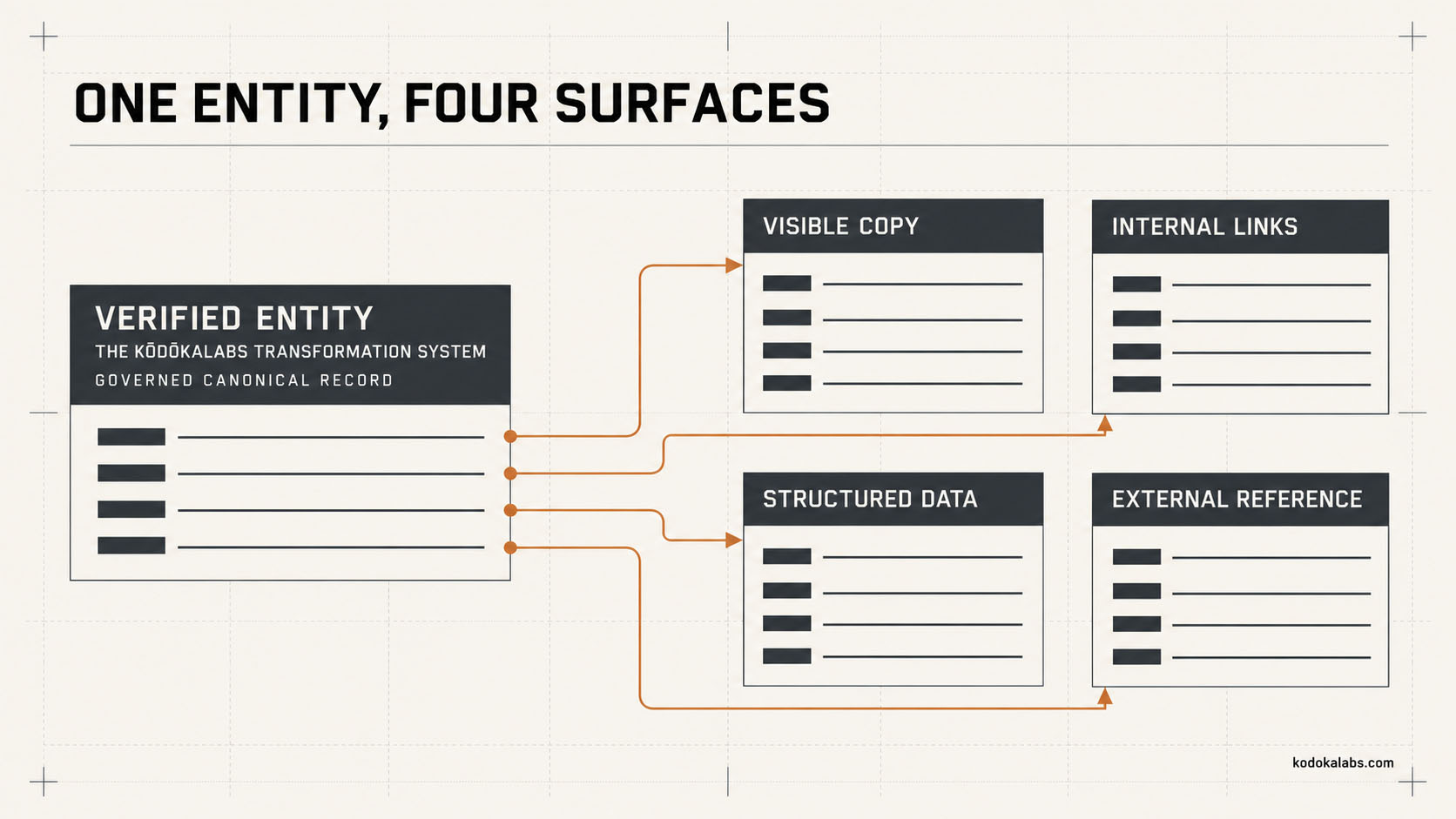
For each entity entering the sprint, build a canonical entity record: a single, structured reference that becomes the source of truth for how that entity is described, linked, and marked up everywhere it appears. This is the sprint’s central artifact, and it is what prevents entity drift once implementation begins.
A canonical entity record captures, at minimum, the entity’s canonical name and any approved aliases, its type (Organization, Person, Service, CreativeWork, or another relevant type), its core attributes, its key relationships to other entities, the page designated as its canonical source, the specific schema properties it should be mapped to, and a scheduled review date. The table below shows this structure applied to two real kōdōkalabs entities, using only verified facts already established on the site; no fabricated field values are used.
| Field | Value (Person: Ben Moll) | Value (Concept: The kōdōkalabs Transformation System) | Owner | Visibility | Schema mapping |
|---|---|---|---|---|---|
| Canonical name | Ben Moll | The kōdōkalabs Transformation System | Founder/content owner | Public | Person / CreativeWork |
| Approved aliases | None (do not shorten or vary the name) | None (never "kōdō Transformation System") | Content owner | Internal | alternateName (only if a genuine, approved alias exists) |
| Core attributes | Founder and CEO of kōdōkalabs; active in print and digital advertising since 2001; core expertise in marketing strategy, SEO, search, analytics, AI, automation, operational design, leadership, team enablement | Six-phase system: Diagnose, Architect, Build, Enable, Measure, Scale | Content owner | Public | jobTitle, description / description |
| Key relationships | Founder and CEO of kōdōkalabs; originator of The kōdōkalabs Transformation System | Originated by kōdōkalabs and Ben Moll; applied across all four solutions | Content owner | Public | worksFor, owns (where implemented) / creator |
| External corroboration | LinkedIn profile (verify live before publication; never copy current DAC role into kōdōkalabs copy) | Not externally corroborated; internal proprietary methodology, labeled as such | Content owner | Public | sameAs (Person only, verified profile) |
Every field in a real canonical entity record needs an assigned owner and a review date; those two columns are placeholders above pending the organization formally assigning them during implementation, and should not be published as if already decided.
Page And Content Implementation
Structured Data And Identity Coordination
Structured data implementation should follow directly from the canonical entity record, not be built independently by whoever happens to touch a page’s schema. Map each verified field to the appropriate schema property, using `mainEntity` to indicate what a page is fundamentally about, `about` for topical relevance short of being the main subject, and `mentions` for a genuine but secondary reference. Mark every property mapping in the implementation specification as required by a known consumer (a documented search feature or platform requirement), recommended (best practice with no confirmed consumer requirement), optional, or internal-only (used for internal consistency, not intended for external consumption); this guide’s examples are illustrative code patterns, not promises that any specific platform will consume or display them.
Coordinate identity across pages that reference the same entity through shared `@id` values where the site’s technical implementation supports it, so that structured data across multiple pages resolves to one consistent entity rather than creating ambiguous duplicate representations. This is a technical implementation detail that should sit with whoever owns the site’s schema architecture, working from the canonical entity record, not improvised page by page.
Corroboration And External Consistency
Where a canonical entity record includes external corroboration, such as a verified social profile or a published work, that corroboration needs periodic revalidation, not a one-time check. External profiles change; a `sameAs` reference that was accurate at implementation can become stale or, worse, actively misleading if the linked profile changes in ways that no longer match the organization’s current facts, as flagged already in the Ben Moll example above regarding his LinkedIn profile.
This guide does not advise manufacturing profiles, citations, or `sameAs` references to create an appearance of corroboration that does not genuinely exist. A missing corroborating source for a new or low-visibility entity is a normal, honest state; it should be logged as a gap in the entity record, not filled with a weak or unrelated substitute.
Validation And Monitoring
After implementation, validate the work against the canonical entity record, not against a generic schema checker alone. Confirm the entity’s name is used consistently, its canonical page is correctly linked from related pages, its structured data accurately reflects the canonical record’s verified fields, and no contradictory or duplicate representation exists elsewhere on the site.
Use a severity model to prioritize what gets fixed first when issues are found.
| Issue | Business risk | Validation evidence | Remediation owner |
|---|---|---|---|
| Contradictory names for the same entity across pages | High: undermines the disambiguation the whole sprint is meant to build | Side-by-side page comparison showing differing names or descriptions | Content owner |
False equivalence (sameAs or similar linking to a non-equivalent identity) |
High: actively misrepresents the entity to any system that trusts the link | Manual review of the linked external profile against the canonical record | Content owner, technical SEO lead |
| Missing provenance (a claim with no traceable source) | Medium: weakens confidence in the entity record without necessarily being wrong | Absence of a source field in the canonical entity record | Content owner |
| Duplicate entity IDs (the same entity represented under two different structured-data identifiers) | Medium: fragments the entity's signal across the site | Technical audit of @id usage across relevant pages |
Technical SEO lead |
| Stale attributes (a canonical record field no longer reflects current fact) | Medium to high, depending on the field: can create an inaccurate public claim | Comparison against the current source-of-truth document | Content owner |
Schedule a recurring review, not a one-time audit, since entity facts (a role, a product scope, a published work) change over time and drift back toward inconsistency without an owner checking periodically.
Sprint Plan And Failure Modes
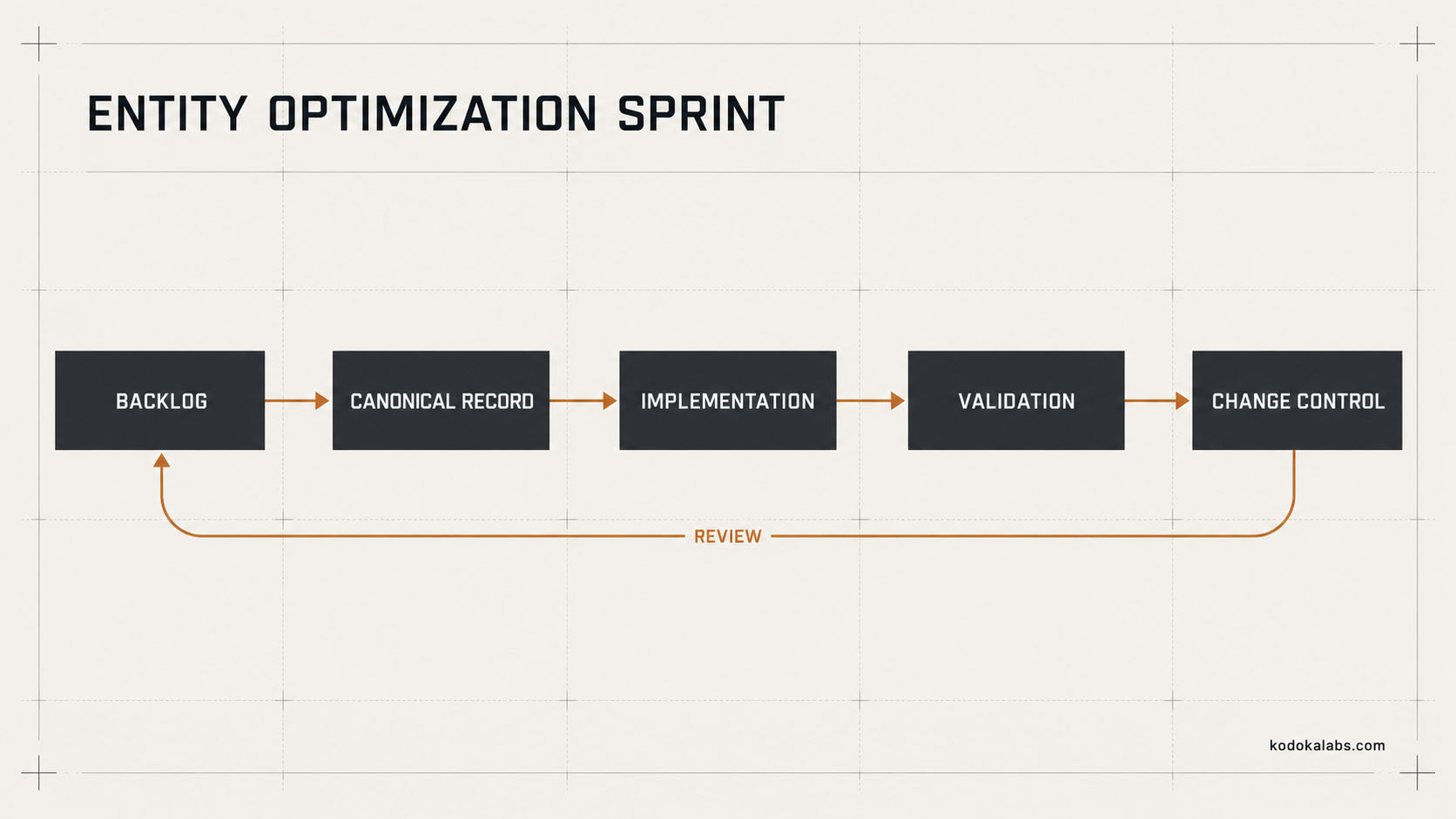
A first Entity Optimization Sprint typically works best scoped to a small number of high-priority entities, perhaps three to five, rather than attempting the full inventory at once. Run the five stages in order: build the backlog, produce canonical entity records for the entities in scope, implement across pages and structured data, validate against the severity model above, and log the outcome with a scheduled review date. Treat the first sprint as a template to refine before scaling to the rest of the entity inventory.
The most common failure mode is skipping the canonical entity record and moving straight to structured data. Without a documented source of truth, technical implementation has nothing authoritative to validate against, and inconsistencies resurface as soon as more than one person touches the content. A second common failure mode is treating validation as a one-time launch step rather than a recurring discipline, which allows entities to drift back out of alignment within months.
Frequently Asked Questions
How is this different from the Entity SEO guide?
Entity SEO explains why entity clarity matters and introduces the underlying concepts. This guide is the practitioner workflow: how to actually run an entity optimization project, artifact by artifact, from backlog to governed change control.
How many entities should a first sprint cover?
Start small, typically three to five high-priority entities, rather than attempting a full-site rollout immediately. A focused first sprint produces a validated template that scales more reliably than an unbounded initial effort.
Do we need a knowledge graph before starting this?
No. A formal knowledge graph, covered in Building a Knowledge Graph for AI Visibility, is a more advanced data architecture for representing many entities and relationships at scale. This sprint can and should happen first, on a smaller set of priority entities, using the canonical-record pattern described here.
What if we cannot corroborate an entity externally yet?
Log the gap honestly in the canonical entity record rather than manufacturing a weak or unrelated substitute. A missing external corroboration is a normal state for a newer or lower-visibility entity.
Who should own the canonical entity records long-term?
Whoever has decision authority over the underlying facts, typically a content or brand owner for most entities, working alongside technical SEO for the structured-data implementation. The record needs one accountable owner, not a shared or ambiguous one.
How often should entity records be reviewed?
On a recurring schedule tied to how likely the underlying facts are to change; a founder's biography might be reviewed annually or on any material change, while a product entity tied to an active roadmap might need quarterly review.
Contextual Solution Pathways
Turn entity strategy into a governed implementation across content, data, and workflows inside the AI Marketing Operating System.