
Structured Data and Schema Markup for AI Search
What Structured Data Can And Cannot Do
Structured data, most commonly implemented as JSON-LD, gives a web page a way to state explicitly, in a machine-readable format, what its visible content is about: which entities it describes, how those entities relate, and what type of content the page represents. That is the whole of what it does. It cannot guarantee a ranking improvement, a rich result appearing in search, inclusion in an AI-generated answer, or a citation. Google’s own current guidance is direct on this point: there is no special schema requirement for its generative AI search features, and structured data eligibility for any specific feature never guarantees that feature will actually display (Google Search Central, structured data introduction and general guidelines, reviewed 2026-09-14).
This guide treats structured data as one governed semantic layer within the broader Search Intelligence capability, valuable for internal consistency and for eligibility toward specific, supported consumer features, never a shortcut around the underlying content quality, entity clarity, technical access, and evidence discipline covered elsewhere in this pillar. A page with excellent, valid structured data and weak, derivative content is not more visible in any meaningful sense than the same weak content without the markup; the markup describes what is already there, it does not compensate for what is missing.
This guide covers Schema.org vocabulary, JSON-LD as the primary recommended format, the concept of a connected node graph, stable `@id` values, the core types relevant to this pillar (`Organization`, `Person`, `WebSite`, `Article`, `BreadcrumbList`, and other context-appropriate types), the `sameAs`, `mainEntity`, `about`, and `mentions` properties, visible-content parity, consumer-specific requirements, WordPress templating implementation, validation, monitoring, ownership, and change control. It does not invent a separate “AI schema” vocabulary, since no platform has documented or required one, and it does not recommend marking up content that is not visible to users, which violates every major search engine’s structured data guidelines.
Vocabulary, Format And Consumers
Schema.org is the shared vocabulary this guide, and virtually all mainstream structured data implementation, is built on: a collaboratively maintained set of types and properties that describe entities and their relationships in a standard way search engines and other consumers can parse (Schema.org documentation, reviewed 2026-09-14). JSON-LD is the format kōdōkalabs recommends for implementation, a block of structured JSON embedded in a page that describes its content, generally easier to implement and maintain within a CMS template than the alternative formats, RDFa and Microdata, which embed structured attributes directly in HTML markup.
A critical distinction this guide insists on: vocabulary validity is not the same as consumer eligibility. A piece of markup can be syntactically valid Schema.org JSON-LD and still not make a page eligible for any specific search feature, because feature eligibility depends on a specific consumer’s own additional requirements, documented separately by each platform, on top of basic vocabulary validity. And consumer eligibility itself is still not a guarantee of a visible outcome; a page can be fully eligible for a feature and simply not be selected to display it, for reasons the consumer platform does not disclose.
| Layer | What it confirms | What it does not confirm |
|---|---|---|
| Vocabulary validity | The markup is syntactically correct Schema.org JSON-LD, parseable without errors | Whether any platform will use, display, or act on it |
| Consumer eligibility | The page meets a specific platform's documented additional requirements for a specific feature (for example, Google's FAQPage guidelines) | Whether that feature will actually display for any given user or query |
| Possible visible outcome | A rich result, generated-answer citation, or other feature may appear | Nothing guarantees it will; platforms select features based on undisclosed criteria |
Entity Graph Design
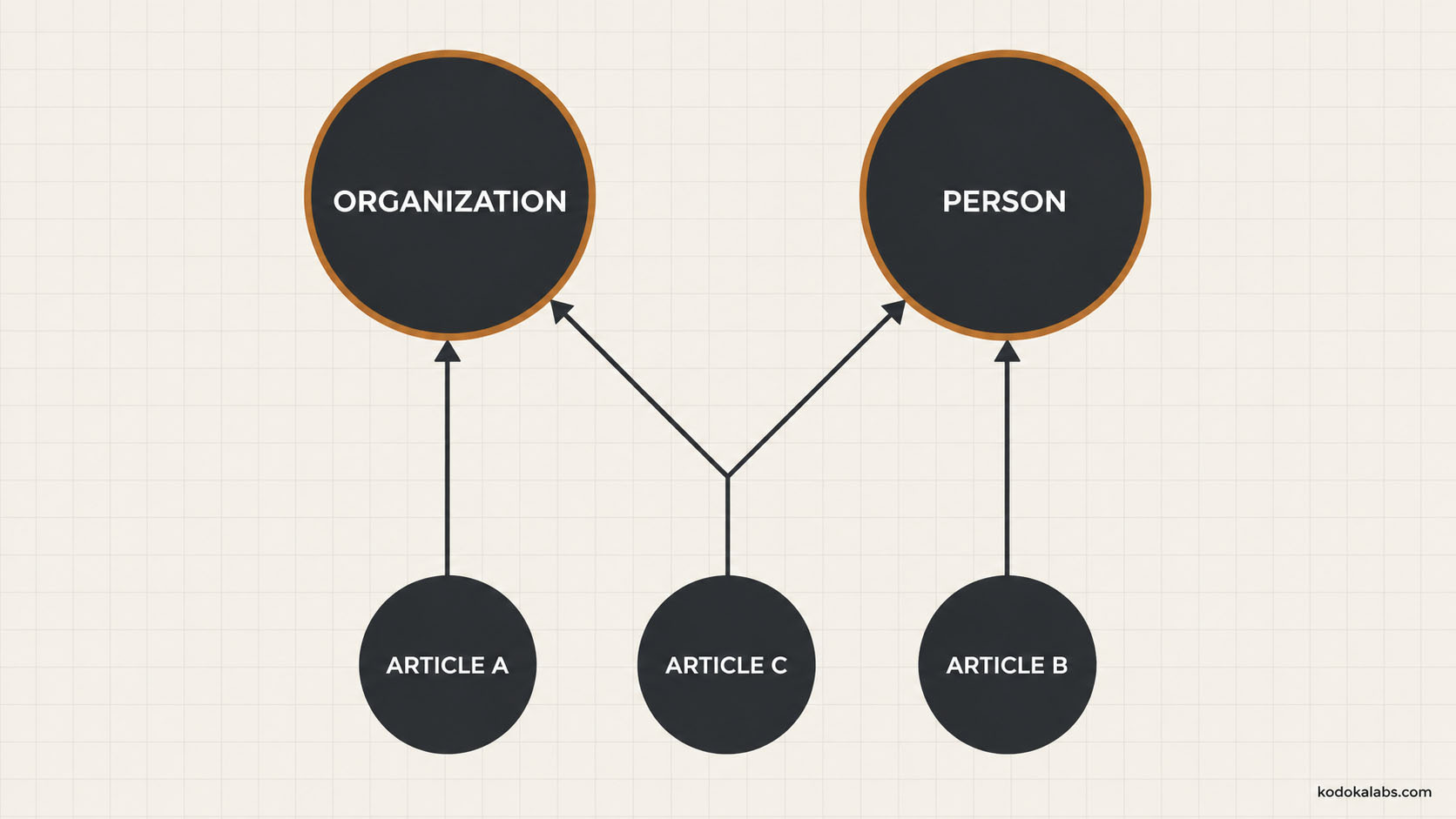
Well-designed structured data across a site behaves as a connected graph, not a set of isolated, page-by-page declarations. The key mechanism for this is the `@id` property: assigning a stable, consistent identifier to a given entity (an Organization, a Person, a specific piece of Content) and reusing that same `@id` everywhere the entity appears in structured data across the site, so that a consuming system can resolve references to the same entity across multiple pages, rather than treating each page’s markup as describing an unrelated, disconnected entity.
Properties like `mainEntity`, `about`, and `mentions` express different strengths of relationship between a page and an entity. `mainEntity` indicates the entity the page is fundamentally, primarily about. `about` indicates a topic the page substantively addresses, without necessarily being the singular main subject. `mentions` indicates a genuine but secondary reference, an entity that appears meaningfully in the content without being a central topic. Using these precisely, rather than defaulting every entity reference to `mainEntity`, keeps the graph accurate rather than inflated.
`sameAs` deserves particular care, since it is easy to misuse. It should link only to genuinely equivalent identity representations of the same entity elsewhere, such as a verified official social profile or an authoritative external record, reviewed at the time of implementation since external pages can change. It should never be used to link to a merely related or topically similar page; doing so creates an inaccurate identity claim, not a helpful cross-reference.
Page-Type Patterns
Different page types on the Intelligence Hub call for different primary structured data patterns, consistent with the page roles established in Semantic Content Architecture.
| Page type | Primary node | Linked nodes | Source fields | Owner |
|---|---|---|---|---|
| Cornerstone guide (this pillar's pages) | Article |
BreadcrumbList, Organization (publisher), Person (author, where applicable via stable @id) |
Title, description, author, publication and modification dates, main content | Content owner |
| Pillar page | WebPage or CreativeWork |
BreadcrumbList, linked child Article entities where appropriate |
Title, description, listed child guides | Content owner |
| Founder/About pages | Person, Organization |
sameAs (verified external profiles only), WebSite |
Verified facts from 08-company-and-founder-facts.md |
Content owner, technical SEO lead |
| Solution/service pages | Service |
Organization (provider), BreadcrumbList |
Service name, description, provider | Content owner |
| FAQ sections within a guide (where genuinely present) | FAQPage |
Question and Answer pairs, matching only visible on-page content | Exact visible question and answer text | Content owner, subject to eligibility review before deployment |
WordPress Implementation
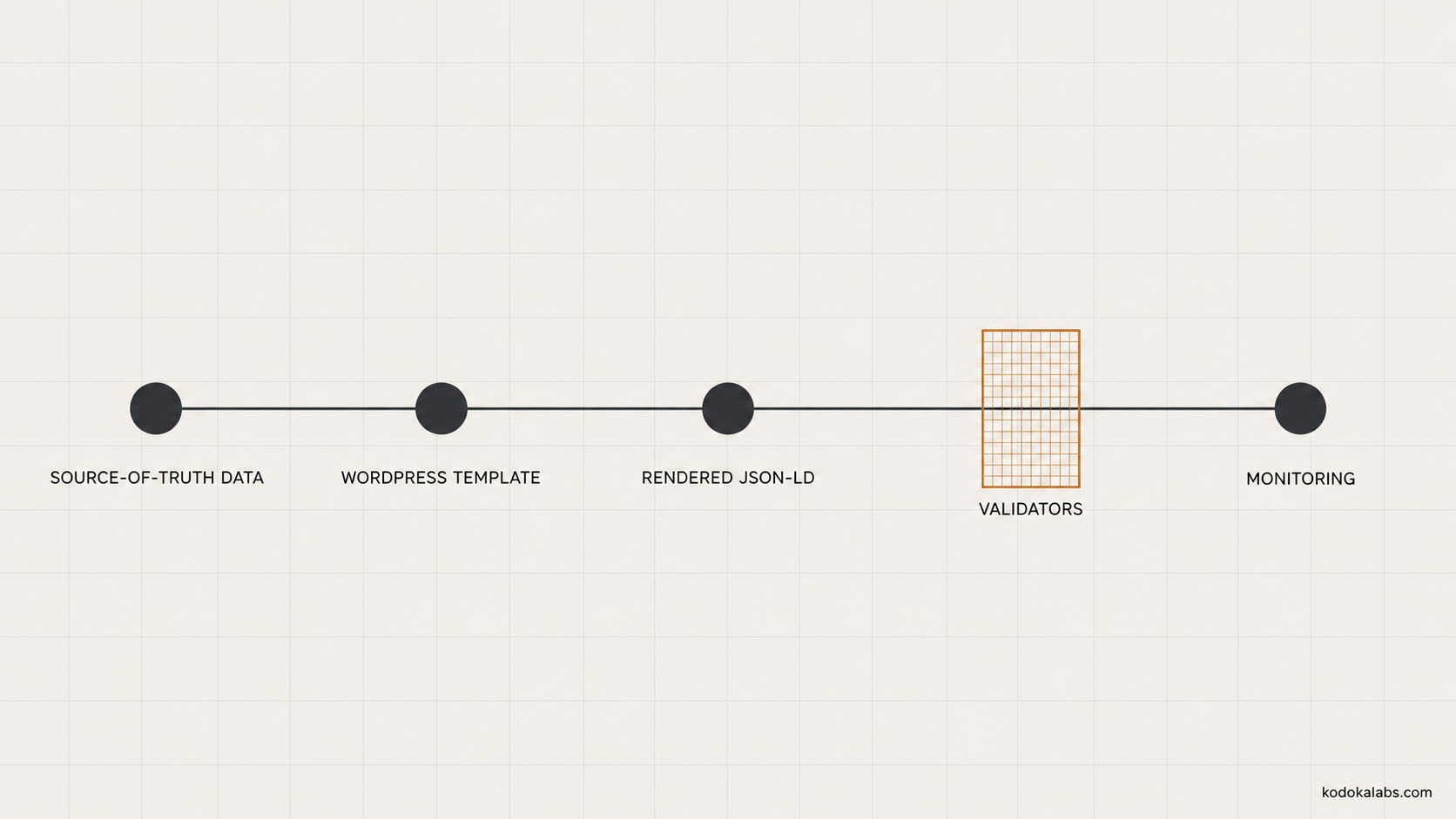
For a WordPress-based implementation, structured data should be generated from the source-of-truth content and entity data, not hand-authored independently on each page, to avoid the drift and duplication risk described throughout this pillar’s entity and knowledge-graph guides. A template-driven approach, where the JSON-LD for a given page type is generated automatically from the page’s actual fields (title, author, dates, linked entities), keeps the markup synchronized with the visible content by construction, rather than requiring a manual update every time content changes.
Where the site’s entity registry (covered in Knowledge Graphs) exists, the WordPress schema templates should draw `@id` values and entity data from that registry rather than duplicating entity facts independently in the schema layer, so a single correction to the registry propagates automatically to every page’s structured data referencing that entity.
Validation And Monitoring: The Three-Layer Validation Model
Validating structured data requires checking three distinct things, not just one, corresponding to the vocabulary, consumer, and outcome layers described earlier.
Syntax and vocabulary validation confirms the JSON-LD is syntactically correct and uses valid Schema.org types and properties. This is a mechanical check, run through a schema validation tool, and should be part of any content or template deployment process, not a one-time manual check.
Consumer eligibility validation confirms the markup meets a specific platform’s additional documented requirements for a specific feature, beyond basic vocabulary validity, checked against that platform’s current, dated guidance rather than assumed to remain stable indefinitely.
Factual and visible-content integrity validation confirms the markup accurately reflects what is genuinely visible on the page: every entity, fact, question, and answer claimed in the structured data actually appears, in substance, in the rendered content a human reader sees. This is the check most likely to be skipped in an automated pipeline, since it requires an editorial review, not just a technical one, and is the one most directly tied to avoiding a misleading or policy-violating implementation.
Governance And Failure Modes
Structured data needs the same kind of governance contract as any other entity or content system in this pillar. kōdōkalabs uses a Schema Governance Contract, recording for each schema node: an assigned owner, its source of truth, which pages or templates it applies to, its required visible fields, its stable `@id`, which specific consumer requirements it is intended to satisfy, the validation test used to confirm it, the deployment owner, a monitoring report showing its current status, and a defined trigger for when it needs to be revisited.
The most common failure mode is treating schema deployment as a one-time technical project rather than an ongoing governance responsibility, so markup drifts out of sync with content as pages are updated over time, eventually describing content that no longer matches what is visibly present, which risks both wasted implementation effort and, in more serious cases, a guideline violation. A second common failure mode is inventing types or properties not present in Schema.org’s actual vocabulary in an attempt to signal something to AI systems specifically; no such special vocabulary exists, and doing so produces invalid markup that consuming systems will likely ignore or, worse, treat as a spam signal.
Examples
Frequently Asked Questions
Does adding FAQPage schema guarantee our FAQ will show as a rich result?
No. It makes the page eligible for that feature if all other requirements are met and the visible content genuinely matches the marked-up questions and answers; whether Google or any platform actually displays the feature is not guaranteed and depends on criteria the platform has not fully disclosed.
Is there a special schema type for AI search visibility?
No. No major platform has published or required an AI-specific schema vocabulary. Standard Schema.org types, correctly and accurately applied, are the current and only documented approach.
Can we mark up content that isn't visible on the page, to give AI systems more context?
No. Every major search engine's structured data guidelines require markup to describe visible content. Marking up non-visible content risks a guideline violation and undermines the trustworthiness of the markup that is genuinely accurate.
How is sameAs different from a regular link?
sameAs different from a regular link?sameAs makes an identity claim, that the linked page represents the same entity, not merely a related one. Use it only for genuinely equivalent identity pages, such as a verified social profile, reviewed at implementation time.
Do we need a developer to implement this, or can content teams do it themselves?
Both roles matter: content teams need to supply and maintain accurate source data (per the entity registry and canonical facts), while a developer implements the template-driven generation that keeps markup synchronized with that source, per the WordPress Implementation section above.
How often should schema be reviewed?
On the change triggers defined in the Schema Governance Contract, at minimum whenever the underlying entity facts change, and periodically to confirm continued compliance with current, evolving platform guidelines for any feature-specific markup like FAQPage.
Contextual Solution Pathways
Replace fragmented page-level markup with a governed schema layer tied to canonical knowledge, as part of a full AI Marketing Operating System engagement.