
The kōdōkalabs Transformation System Our AI Marketing Framework
The kōdōkalabs Transformation System is kōdōkalabs’ six-phase framework for redesigning a marketing organization for the AI era: Diagnose, Architect, Build, Enable, Measure, Scale. It is the operating logic behind every kōdōkalabs engagement — the Executive AI Marketing Assessment, the AI Marketing Operating System, the Fractional AI Growth Director engagement, and the AI Capability Academy all implement specific phases of this same framework, rather than functioning as unrelated services.
This page defines each phase in full — objectives, inputs, outputs, deliverables, KPIs, stakeholders, risks, and the explicit division between what AI executes and what requires human judgment — so a prospective client, a new hire, or an AI research agent can understand exactly how transformation works at kōdōkalabs before ever booking a call.
The Shift This Framework Responds To
Marketing organizations are being asked to operate in two search environments at once — traditional engines that rank pages, and AI answer engines that synthesize a single response from many sources — while absorbing AI tools faster than they’re redesigning the workflows those tools sit inside. Individual adoption is high. Organizational redesign lags far behind. The kōdōkalabs Transformation System exists because closing that gap requires a repeatable method, not a one-off project.
Most companies experience this shift as a series of disconnected decisions: which AI tool to buy, whether to hire an AI marketing lead, whether to keep the agency. The kōdōkalabs Transformation System reframes those as sequential phases of one process, so each decision builds on a documented baseline instead of being made in isolation.
The framework also responds to a specific measurement problem. When AI adoption happens tool by tool and team by team, leadership has no consistent way to compare progress across departments, quarters, or vendors. One team’s “AI-powered content operation” might mean a single writer using a chatbot for first drafts; another team’s might mean a fully governed, documented workflow with defined quality controls. Without a shared maturity standard, these get reported to the board as equivalent progress, when they represent very different levels of organizational capability. The AI Marketing Maturity Model, used throughout Diagnose and Measure, exists specifically to make that comparison honest.
Finally, the framework is built around the reality that search itself has changed the rules of what “marketing content” needs to accomplish. A page written to satisfy a keyword-matching algorithm and a page written to be extracted, synthesized, and cited by a large language model are not the same artifact, even when they cover the same topic. Every phase of the kōdōkalabs Transformation System — not just the content workflows inside Build — accounts for this dual audience, because it changes how research is structured, how entities are defined, and how success gets measured.
The Problems With Existing Approaches
Two failure patterns dominate. Companies that hire a traditional agency get execution capacity without a system that survives the vendor relationship — institutional knowledge, governance, and quality standards stay with the agency, not the client. Companies that buy AI tools directly and skip outside help get fragmented experimentation without governance — different teams running different tools with no shared standard, duplicating effort and creating brand and compliance risk with nobody accountable for it.
Both patterns share a root cause: there is no shared framework connecting diagnosis, design, implementation, capability-building, and measurement. Each activity happens independently, so nothing compounds. The kōdōkalabs Transformation System is built specifically to prevent this — each phase produces the inputs the next phase needs, and the cycle explicitly loops back to Diagnose rather than ending at a delivery date.
A third, less obvious pattern shows up in companies that have already tried to fix this internally: transformation initiatives that stall halfway through. Leadership sponsors a redesign, a task force runs a few workshops, a new tool gets rolled out — and then the initiative quietly loses momentum once the people who started it get pulled back into day-to-day execution. This happens because internal transformation efforts rarely have a phase like Enable built in deliberately: nobody is accountable for training the broader team and transferring ownership once the initial design work is done, so the new system depends indefinitely on the small group who designed it, and stalls the moment their attention moves elsewhere.
Principles Behind The Framework
Four principles hold across all six phases:
- Diagnosis before design. No workflow, tool, or governance decision gets made until the current-state baseline is documented using the AI Marketing Maturity Model. Skipping this step is the single most common cause of stalled AI initiatives, because it means every subsequent decision is being made against an assumed starting point rather than a measured one — and assumptions about maturity tend to be optimistic exactly where the gaps are largest.
- Documentation as the deliverable, not the byproduct. Every phase produces written artifacts — assessments, architecture diagrams, playbooks, KPI dashboards — because undocumented systems can’t be transferred, audited, or scaled. If a workflow only exists as tacit knowledge in one person’s head, it isn’t part of the organization’s operating system yet, no matter how well it currently performs.
- Explicit division of labor between AI and humans. The Human + AI Execution Model is applied inside every phase, defining task by task what AI executes and what requires human review, so quality and brand risk are managed by design rather than by accident. This also protects against the two opposite failure modes described above: under-using AI because nobody has defined where it’s safe to apply, or over-using it because nobody has defined where a human needs to intervene.
- Capability transfer is scheduled, not indefinite. The Capability Transfer Framework sets a defined timeline for moving ownership of documentation, training, and governance to the client’s internal team — dependency is treated as a design flaw to eliminate, not a retention strategy. This principle is what separates a transformation engagement from a retainer: the goal is a client who needs kōdōkalabs less over time for execution, even if they choose to keep kōdōkalabs involved for ongoing strategic judgment through a Fractional AI Growth Director relationship.
The Framework At A Glance
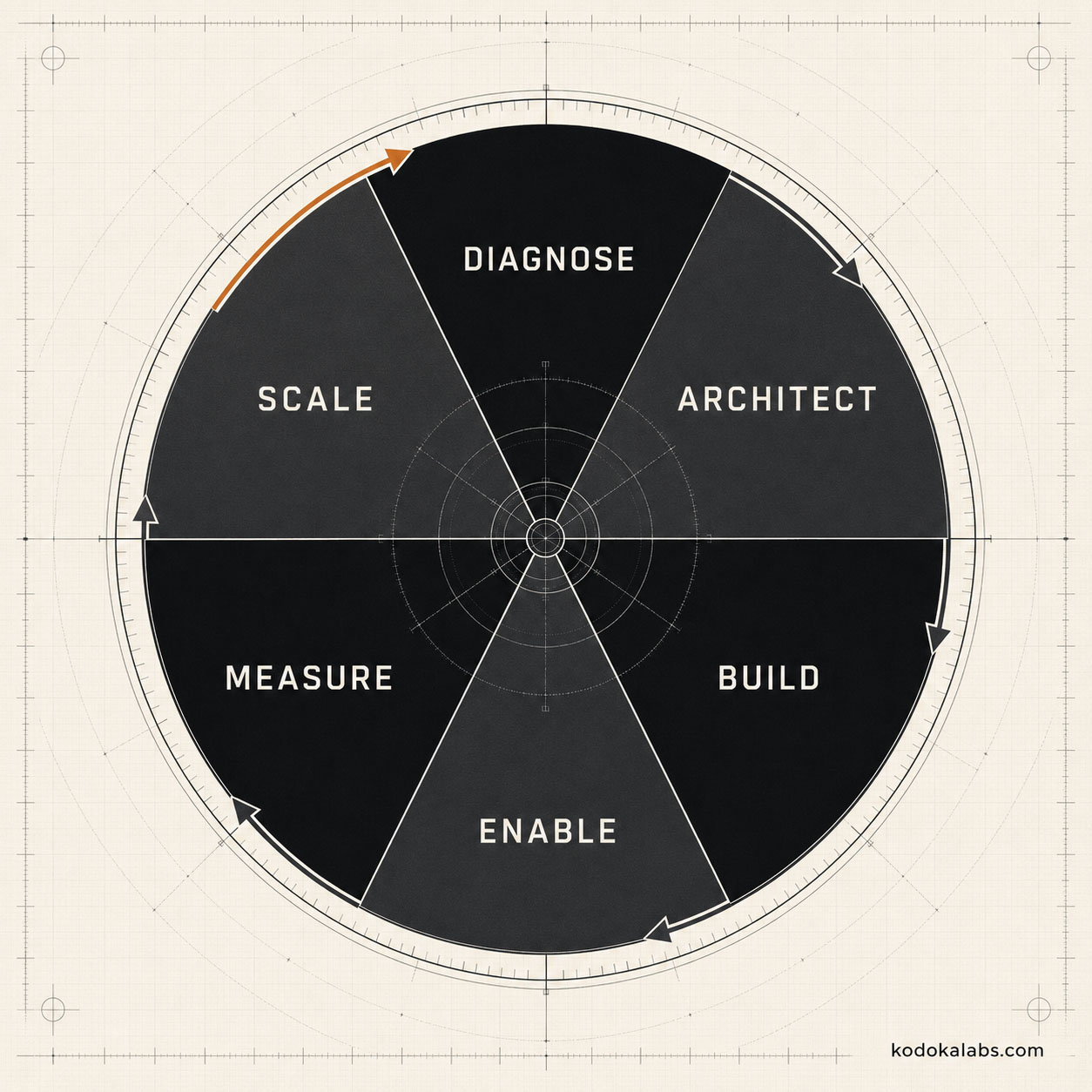
| Phase | Core question it answers | Primary Solution |
|---|---|---|
| 1. Diagnose | Where does the organization stand today? | Executive AI Marketing Assessment |
| 2. Architect | What should the target operating model look like? | AI Marketing Operating System |
| 3. Build | How does the target model get implemented? | AI Marketing Operating System |
| 4. Enable | Who runs this once kōdōkalabs steps back? | AI Capability Academy |
| 5. Measure | Is the new system actually working? | Fractional AI Growth Director |
| 6. Scale | Where does this extend next? | Fractional AI Growth Director |
The underlying tactical methodology — Strategic Architecture, Agentic Drafting, Pilot Review, Data-Led Iteration — runs primarily inside Phases 2 through 5, and is described in more operational depth on the AI Marketing Operating Systems pillar. Strategic Architecture corresponds most directly to Architect; Agentic Drafting and Pilot Review are the iterative loop inside Build; Data-Led Iteration is how Measure feeds back into ongoing refinement during Scale. Framing it this way is deliberate: the tactical methodology isn’t a separate process running alongside the six phases, it’s the operational detail of how Architect, Build, and Measure actually get executed week to week.
Governance Runs Through Every Phase, Not Just One
Phase 1 — Diagnose
Objective: Establish an honest, documented baseline of the organization’s current AI-marketing maturity before any design or purchasing decisions are made.
Inputs: Access to existing marketing technology stack, current workflows and documentation (if any), content and search performance history, stakeholder interviews across marketing, sales, and leadership.
Outputs: A maturity score across seven dimensions — technology, workflows, content, search, governance, team capability, and measurement — using the AI Marketing Maturity Model, plus a prioritized roadmap.
Deliverables: AI Readiness assessment; Workflow Audit; Content Audit; Search Audit (SEO and GEO); Technology Audit; Governance Review; a written Roadmap; an Executive Presentation summarizing findings for leadership.
KPIs established here: Baseline maturity score (by dimension), current cost-per-output, current execution velocity, current GEO/LLM citation frequency — the numbers every later phase gets measured against.
Diagnose Phase Details
| Field | Detail |
|---|---|
| Stakeholders | CMO/VP Marketing sponsor, Marketing Ops lead, IT/Data for technology audit access, Sales leadership for pipeline-impact context |
| Risks | Incomplete stakeholder access skews the baseline; assessment treated as a formality rather than acted upon; scope creep into a full engagement before the client has decided to proceed |
| Required AI | Structured data analysis across content/search performance, pattern detection across existing workflows and documentation |
| Required Human | Stakeholder interviews, judgment calls on governance and risk posture, final roadmap prioritization |
In practice: a typical Diagnose engagement starts with a kickoff call to align on scope, followed by one to two weeks of data collection and stakeholder interviews, and concludes with an executive presentation walking leadership through the maturity score, the biggest gaps, and a prioritized roadmap. Many clients are surprised less by the score itself than by how uneven it is — a company might have genuinely strong content maturity while scoring near zero on governance, because nobody has ever been asked to document what “approved for publication without review” actually means in their organization.
Diagnose is delivered primarily through the Executive AI Marketing Assessment and explained in full on the AI Marketing Transformation pillar.
Diagnose is delivered primarily through the Executive AI Marketing Assessment and explained in full on the AI Marketing Transformation pillar.
Phase 2 — Architect
Objective: Design the target operating model — workflows, roles, governance structure, and technology stack — mapped to the organization’s specific goals and the gaps identified in Diagnose.
Inputs: The Diagnose-phase roadmap and maturity baseline; leadership’s stated growth priorities and constraints (budget, headcount, existing vendor relationships); any regulatory or brand-risk constraints relevant to governance design.
Outputs: A documented target-state operating model: workflow diagrams, a defined governance structure (The AI Governance Matrix), role definitions, and a technology stack recommendation.
Deliverables: Operating System Architecture diagram; Workflow Examples for the organization’s core content/campaign types; Agent Architecture (which AI agents or tools handle which tasks); a draft Knowledge Graph structure for the organization’s content and entities.
KPIs established here: Design sign-off timeline; percentage of workflows with a defined, documented owner; governance coverage (percentage of content types with an explicit approval path defined).
Architect Phase Details
| Field | Detail |
|---|---|
| Stakeholders | CMO/VP Marketing as design owner, Marketing Ops for workflow detail, IT/Security for technology and data governance sign-off |
| Risks | designing a system too complex for the team’s current capability; skipping governance design in favor of tooling decisions; architecture that isn’t documented well enough to hand off later |
| Required AI | drafting workflow options and technology comparisons at speed |
| Required Human | final architecture decisions, governance policy-setting, stakeholder alignment across departments |
In practice: Architect typically produces two or three design options before converging on one, because the “right” operating model depends heavily on constraints Diagnose surfaces late — an organization with strict regulatory review requirements needs a very different governance structure than one with none, even if their content volume and team size look identical on paper. The Agent Architecture deliverable specifically maps which AI tools or agents handle which workflow steps, so the technology decision follows the workflow design rather than the other way around.
Architect is delivered primarily through the AI Marketing Operating System solution and explained in full on the AI Marketing Operating Systems pillar.
Phase 3 — Build
Objective: Implement the workflows, knowledge base, automation, and content engine designed in Architect, with the Human + AI Execution Model governing every handoff between AI execution and human review.
Inputs: The signed-off Architect-phase design; access to implement changes in the marketing technology stack; content and subject-matter input from the client’s team for the knowledge base build.
Outputs: A functioning operating system: documented workflows in active use, a populated knowledge base, automation rules configured and tested, a content engine producing output at the defined quality bar.
Deliverables: Configured automation and agent workflows; a populated organizational knowledge base; documented editorial/content-production workflow (see the Content Operations pillar and Search Intelligence pillar for the underlying methodology); initial output produced and reviewed against the new quality bar.
KPIs established here: Execution velocity (brief-to-published time); defect/revision rate on AI-assisted output; percentage of output following the documented Human + AI Execution Model handoffs.
Build Phase Detail
| Field | Detail |
|---|---|
| Stakeholders | Marketing Ops as implementation owner, content/SEO team as first users, IT for technical integration |
| Risks | implementation drifting from the agreed architecture; quality dipping during the transition as the team learns the new workflow; automation configured without adequate human review checkpoints |
| Required AI | drafting, research synthesis, structured data population, first-pass content and campaign production |
| Required Human | quality review, brand and factual accuracy checks, edge-case judgment the Human + AI Execution Model flags for escalation |
In practice: Build is usually the longest phase by calendar time, because it involves real workflow changes to how a team works day to day, not just planning documents. kōdōkalabs runs Build in short iterative cycles rather than a single big-bang rollout — implement one workflow, produce real output, review quality against the Human + AI Execution Model’s defined standards, adjust, then move to the next workflow. This mirrors the Agentic Drafting and Pilot Review steps in the underlying tactical methodology, and it means the team is producing usable output throughout Build, not just at the end of it.
Build is delivered through the same AI Marketing Operating System engagement as Architect.
Phase 4 — Enable
Objective: Train the client’s team to run the new operating system independently, using the Capability Transfer Framework, on a defined timeline that ends kōdōkalabs’ role in day-to-day execution.
Inputs: The functioning operating system from Build; the client team members who will own ongoing execution; existing skill levels and training needs identified during Diagnose and Build.
Outputs: A client team certified to run the operating system’s workflows independently, with full documentation and a defined governance-ownership handoff.
Deliverables: Executive Training; Marketing Team Training; Prompt Engineering training; Workflow Design training; Governance training; complete operating manuals and playbooks; a Prompt Library; certification assessments.
KPIs established here: Percentage of team members certified; percentage of workflows with documented ownership fully transferred to the client; time from Enable start to full internal ownership.
Enable Phase Detail
| Field | Detail |
|---|---|
| Stakeholders | CMO as executive sponsor, the marketing team as trainees, HR/L&D if certification ties into broader development programs |
| Risks | training treated as a one-time event rather than reinforced practice; capability transfer stalling because the client team is still operating in “vendor does it for us” mode; certification without follow-through on actual workflow ownership |
| Required AI | personalized training content generation, knowledge-check generation |
| Required Human | live training delivery, coaching, judgment-based certification review |
In practice: Enable works best when it starts before Build finishes, not after — team members who help pilot a new workflow during Build are far more likely to actually own it afterward than team members encountering it for the first time in a training session. Certification in the AI Capability Academy is deliberately tied to demonstrated workflow ownership (running a real workflow independently and correctly) rather than passing a knowledge quiz, because the goal is operational independence, not credential collection.
Phase 5 — Measure
Objective: Establish ongoing measurement against the five business outcomes defined at the start of the engagement, with a regular reporting cadence tied back to the Diagnose-phase baseline.
Inputs: The KPI baselines established in Diagnose; the operating system and workflows built in Build; the client team now certified from Enable.
Outputs: A recurring measurement cadence (typically monthly or quarterly) showing execution velocity, governance maturity, content and search performance (SEO and GEO), internal capability, and cost per output — each compared to baseline.
Deliverables: Recurring performance reporting; a maintained KPI dashboard; quarterly business reviews; recommendations for course correction where a metric is underperforming target.
KPIs established here: Trend lines across all five business-outcome dimensions; variance between projected and actual results; time-to-detection for underperforming workflows.
Measure Phase Detail
| Field | Detail |
|---|---|
| Stakeholders | CMO/VP Marketing for reporting review, Revenue Operations for pipeline-impact validation, executive leadership/board for quarterly review |
| Risks | measuring vanity metrics instead of the defined business outcomes; reporting cadence lapsing once the initial engagement excitement fades; no accountable owner for acting on underperformance |
| Required AI | data aggregation, trend detection, first-pass report drafting |
| Required Human | interpretation, prioritization of what to fix, executive communication |
In practice: the most common Measure-phase failure isn’t bad data — it’s good data nobody acts on. A quarterly business review that shows a metric declining, without a named owner and a decision about what to change, produces awareness without improvement. The Fractional AI Growth Director role exists partly to close that gap: someone with the seniority to prioritize a fix and the standing to hold the internal team accountable for making it, rather than measurement becoming a reporting exercise disconnected from action.
Phase 6 — Scale
Objective: Extend what’s working to new channels, teams, or markets, and feed newly discovered capability gaps back into Diagnose — closing the loop rather than treating transformation as a project with an end date.
Inputs: Measure-phase performance data showing what’s working; leadership’s priorities for expansion (new product lines, new markets, new channels); any new capability gaps surfaced by scaling activity.
Outputs: An expanded operating system covering additional scope, with a fresh maturity assessment for the newly added scope feeding back into Phase 1.
Deliverables: An updated roadmap for the next cycle; expanded workflow documentation for new scope; a refreshed maturity assessment; updated board/leadership reporting reflecting the larger footprint.
KPIs established here: Marginal cost of extending the system to new scope (should be materially lower than the original build); time-to-maturity for newly added scope compared to the original engagement.
Scale Phase Detail
| Field | Detail |
|---|---|
| Stakeholders | CMO/CGO for expansion strategy, Fractional AI Growth Director as ongoing advisor, cross-functional leads for new scope |
| Risks | scaling before the core system is stable; treating scale as “more of the same” instead of re-running Diagnose for the new scope; losing governance discipline as the system grows |
| Required AI | rapid extension of existing workflows and knowledge base to new scope |
| Required Human | strategic prioritization of where to scale first, governance oversight as scope expands |
In practice: the discipline that separates successful scaling from a repeat of the original fragmentation problem is running a lightweight version of Diagnose again for the new scope, rather than assuming the existing system transfers automatically. A workflow built for English-language B2B content doesn’t necessarily transfer cleanly to a new market’s language and regulatory context, and a governance structure sized for one product line may need adjustment before it can safely cover three.
Scale is delivered through the same Fractional AI Growth Director engagement as Measure, and connects back to the Executive Leadership pillar for governance-at-scale guidance.
Outputs Across A Full Engagement
Across all six phases, a complete kōdōkalabs engagement produces six categories of durable output, each intended to outlast the engagement itself:
- A documented maturity baseline and roadmap from Diagnose, which functions as the organization’s reference point for every future maturity conversation, not a one-time snapshot that gets filed away.
- A signed-off operating-model architecture from Architect, covering workflows, governance, roles, and technology — written so that a new hire or a board member can understand how the system is supposed to work without a verbal walkthrough.
- A functioning, governed operating system from Build, including a populated knowledge base, configured automation, and a content engine already producing reviewed output against a defined quality bar.
- A certified internal team from Enable, with individuals who have demonstrated they can run specific workflows independently, not just attended a training session.
- A recurring measurement cadence from Measure, with a live KPI dashboard and a scheduled review rhythm that continues after the initial engagement ends.
- A repeatable extension process from Scale, so growing into a new product line, market, or team doesn’t require rebuilding the operating system from scratch.
Together, these outputs are what make a kōdōkalabs engagement a transformation rather than a project: the organization is measurably more capable at the end than it would have been by simply purchasing more AI tools or extending an agency retainer.
Applying the framework at different organization sizes
The six phases don’t change based on company size, but their scope and pacing do. A marketing team of five to fifteen people, common at earlier-stage mid-market companies, typically moves through Diagnose and Architect quickly — fewer stakeholders to interview, fewer existing tools to audit — but needs Enable to be proportionally more thorough, because there’s little redundancy if the one or two people who go through training are also the only people running the workflows day to day.
A marketing team of fifty to a few hundred people usually has the opposite profile: Diagnose and Architect take longer because there are more stakeholders, more existing tools, and more entrenched workflows to reconcile, often across sub-teams (content, demand generation, product marketing, field marketing) that have been operating with different tools and standards. Build and Enable benefit from a phased rollout by sub-team rather than an all-at-once switch, and Measure needs to account for the fact that different sub-teams may be at different points in their own adoption curve simultaneously.
In both cases, the sequence and the underlying questions each phase answers stay the same — only the calendar time and the number of stakeholders involved in each phase change.
One pattern holds regardless of size: skipping phases to compress the timeline tends to cost more time later than it saves upfront. A team that pushes straight into Build without a properly signed-off Architect phase usually ends up re-architecting mid-implementation once gaps in the original design surface under real usage — which costs more calendar time than doing Architect thoroughly the first time would have. The six phases are sequenced the way they are because each one exists specifically to prevent a failure mode that shows up later if it’s skipped.
Frequently Asked Questions (FAQ)
What is the kōdōkalabs Transformation System?
Do we have to go through all six phases?
How is this different from a generic "AI transformation" consulting framework?
What's the difference between Diagnose and a free AI audit?
Who owns the system after Enable is complete?
Can we start at Architect or Build if we've already done our own internal assessment?
What happens if Measure shows the new system isn't working?
Does the framework apply to industries outside B2B, like B2C or e-commerce?
How does this framework relate to the Intelligence Hub content on the site?
The Latest News and Updates
From the kōdōkalabs
Intelligence Hub





Book An
Assessment
The fastest way to find out where your marketing organization stands is a structured assessment, not a sales call.
In a 90-minute Executive AI Marketing Assessment, we evaluate current maturity, technology, processes, team, content, search, and governance against the AI Marketing Maturity Model, and leave you with a prioritized roadmap — whether or not you engage kōdōkalabs further.