
Generative Engine Optimization (GEO):
A System for AI Search Visibility
Generative Engine Optimization, defined
What This Guide Solves
What This Guide Does Not Cover
Why Generated Answers Change Discovery
For two decades, search visibility meant one thing: a ranked list of links, with success measured in position and click-through. Generated answers introduce a second, parallel output. When a user asks a question and a platform returns a synthesized answer, paraphrased content, and in many cases a small set of cited or linked sources, that answer becomes the reader’s first encounter with an organization’s expertise, whether or not the reader ever clicks through.
This changes three things for marketing and content leaders. First, the unit of competition shifts. Instead of competing to rank a page, organizations increasingly compete to be selected as a trustworthy input to someone else’s synthesis. Second, attribution becomes harder. A generated answer may draw on a page without a visible citation, may cite a competitor’s page that better demonstrates the same fact, or may satisfy the user’s question well enough that no click ever occurs, a pattern often called zero-click. Third, the criteria for selection are not fully disclosed. Google is explicit that normal SEO foundations, such as pages being crawlable, indexable, and technically sound, remain relevant to appearing in AI features, and that it recommends useful, original content rather than content engineered for extraction. It has also explicitly rejected the idea that special AI markup, artificially small content “chunks,” or a file such as `llms.txt` are requirements for Google Search (Google Search Central, AI features and your website; Google Search Central, optimizing for generative AI features, reviewed 2026-09-14).
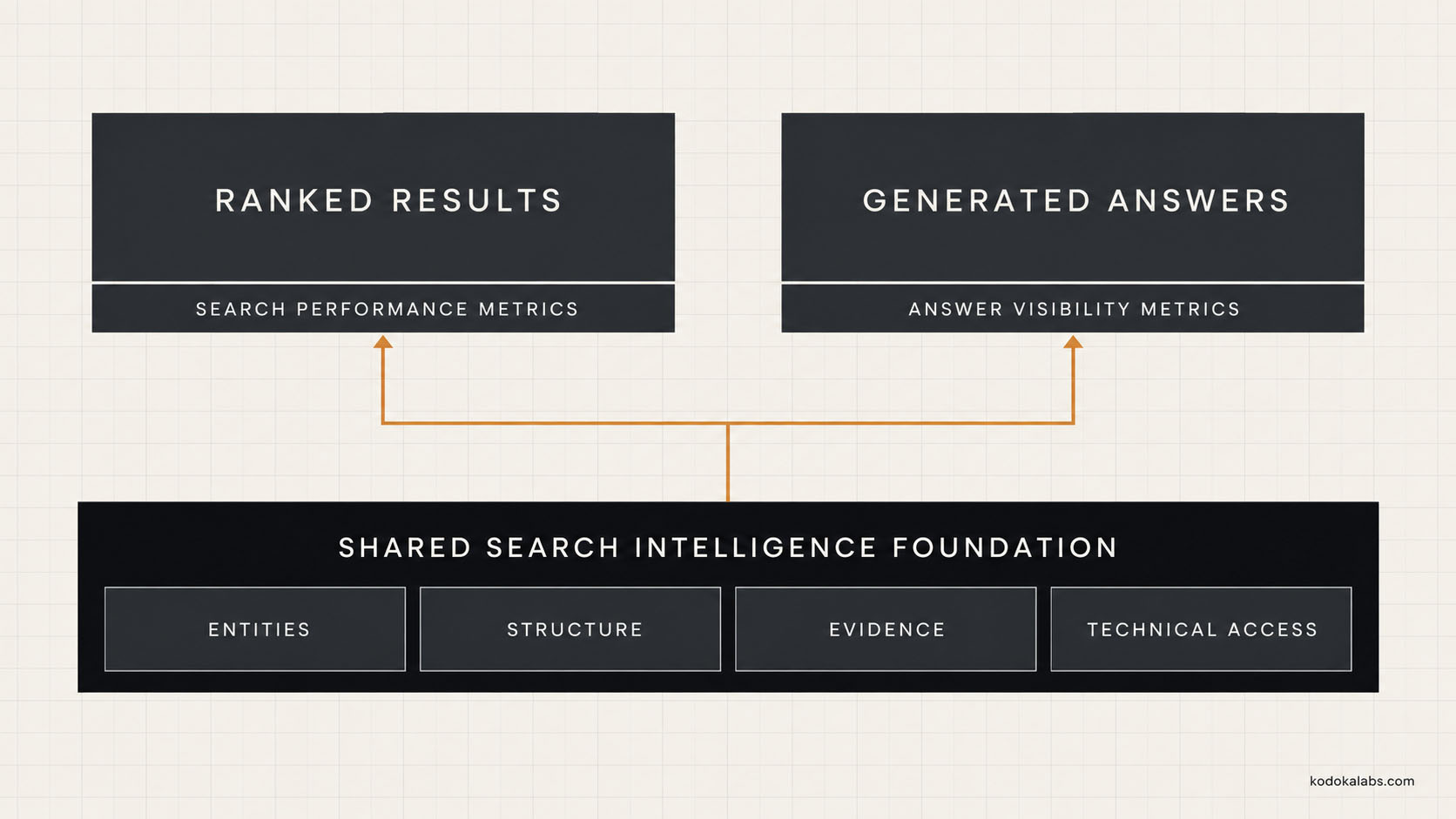
None of this means traditional discovery is being replaced. Ranked results, organic listings, and direct navigation remain the dominant way most users reach most content today. What has changed is that organizations now need to design for two connected outputs, ranked results and generated answers, from one shared foundation of entities, evidence, and technical accessibility, rather than treating GEO as a bolt-on tactic applied after the fact.
SEO and GEO: one system, different surfaces
SEO and GEO are frequently framed as competitors, with some commentary suggesting GEO will replace SEO outright. That framing does not match how these systems actually work. AI-mediated discovery systems are, in large part, built on the same crawling, indexing, and content-understanding infrastructure that traditional search relies on. A page that cannot be crawled, cannot be rendered, or carries no clear topical signal is not more likely to be selected for a generated answer; it is less likely, for the same underlying reasons it would rank poorly in traditional search.
What differs is the output surface, the way content is consumed once selected, and some of the specific technical and evidentiary requirements for that consumption. The table below sets out the practical differences kōdōkalabs treats as decision-relevant, without implying the two disciplines are unrelated.
| Dimension | Traditional SEO (ranked results) | Generative engine optimization (GEO) |
|---|---|---|
| User experience | A ranked list of links the user evaluates and clicks | A synthesized answer the user reads directly, sometimes with linked or cited sources, sometimes with none |
| Controllable inputs | Technical crawlability, on-page structure, internal linking, content quality, backlink profile | The same foundation, plus entity clarity, extractable structure, corroborating evidence, and platform-specific access controls |
| Dependencies | Search engine crawling and ranking systems, largely documented over 20+ years of practitioner and platform guidance | Retrieval and generation systems, some newer and less publicly documented, with fewer disclosed mechanics and faster platform change |
| Metrics | Rankings, organic sessions, click-through rate, conversions from organic traffic | Citation presence, mention and representation accuracy, referral traffic where trackable, share of voice in sampled answer panels |
| Limitations | Rankings are visible and directly measurable; attribution to specific tactics is still probabilistic | Generated answers may omit citations entirely, sample sizes for any tracking method are necessarily partial, and platforms can change retrieval behavior without notice |
How Source Selection Works
No AI platform has published a complete account of how it selects sources for a generated answer, and any claim to the contrary should be treated skeptically. What platforms have disclosed, and what kōdōkalabs treats as a reliable foundation for strategy, falls into a few documented categories.
Google has stated that AI Overviews and AI Mode can use a technique it calls query fan-out, issuing multiple related searches behind the scenes to gather a broader set of supporting information before generating a response, and that the underlying content must meet the same indexability and snippet-eligibility bar as traditional search features (Google Search Central, AI features and your website, reviewed 2026-09-14). Google has also stated directly that there is no special content format, markup, or file required to be eligible for its AI features beyond sound technical SEO and genuinely useful content (Google Search Central, optimizing for generative AI features, reviewed 2026-09-14).
OpenAI documents a distinction between discovery and training controls for ChatGPT. Its `OAI-SearchBot` crawler is used to discover and retrieve content that ChatGPT can search and potentially cite, separate from `GPTBot`, which is used for model training and can be controlled independently. OpenAI is explicit that allowing `OAI-SearchBot` access is necessary for eligibility but does not guarantee placement, and that cited results can still be incomplete or inaccurate (OpenAI, searching the web with ChatGPT; OpenAI publisher and developer FAQ, reviewed 2026-09-14). ChatGPT also supports referral tagging on outbound links, which organizations can use to measure traffic that does arrive by click.
Perplexity publishes documentation of its distinct crawler behaviors, including separate user-agent strings and IP ranges for indexing crawlers versus real-time user-triggered fetches, giving organizations a documented basis for access-control decisions rather than guesswork (Perplexity, crawler documentation, reviewed 2026-09-14). Microsoft describes Copilot as using web grounding with linked citations to support its answers, while also cautioning elsewhere in its own support guidance that generated answers can still be inaccurate, meaning grounding and citation are not the same as verification (Microsoft, Copilot transparency note, reviewed 2026-09-14). Bing’s AI Performance reporting, introduced in its Webmaster Tools public preview, gives site owners citation counts, cited pages, and a sample of grounding queries, with Microsoft’s own documentation flagging important limits on how that sampled data should be interpreted (Bing Webmaster Tools, Introducing AI Performance, reviewed 2026-09-14).
Two structural points follow from this evidence. First, crawler access is necessary but not sufficient. A platform’s documented crawler being allowed to fetch a page is a prerequisite for consideration, not a guarantee of citation, mention, or accurate representation. Second, none of these platforms have disclosed a ranking algorithm for generated answers in the way search engines have gradually disclosed aspects of traditional ranking over two decades. Any vendor or consultant presenting a definitive, numbered list of “GEO ranking factors” is presenting inference as documented fact. kōdōkalabs’ approach is to separate what a platform has stated from what is reasonable practitioner inference, and to label each accordingly.
Install
Enable
Transfer
The GEO Capability Architecture
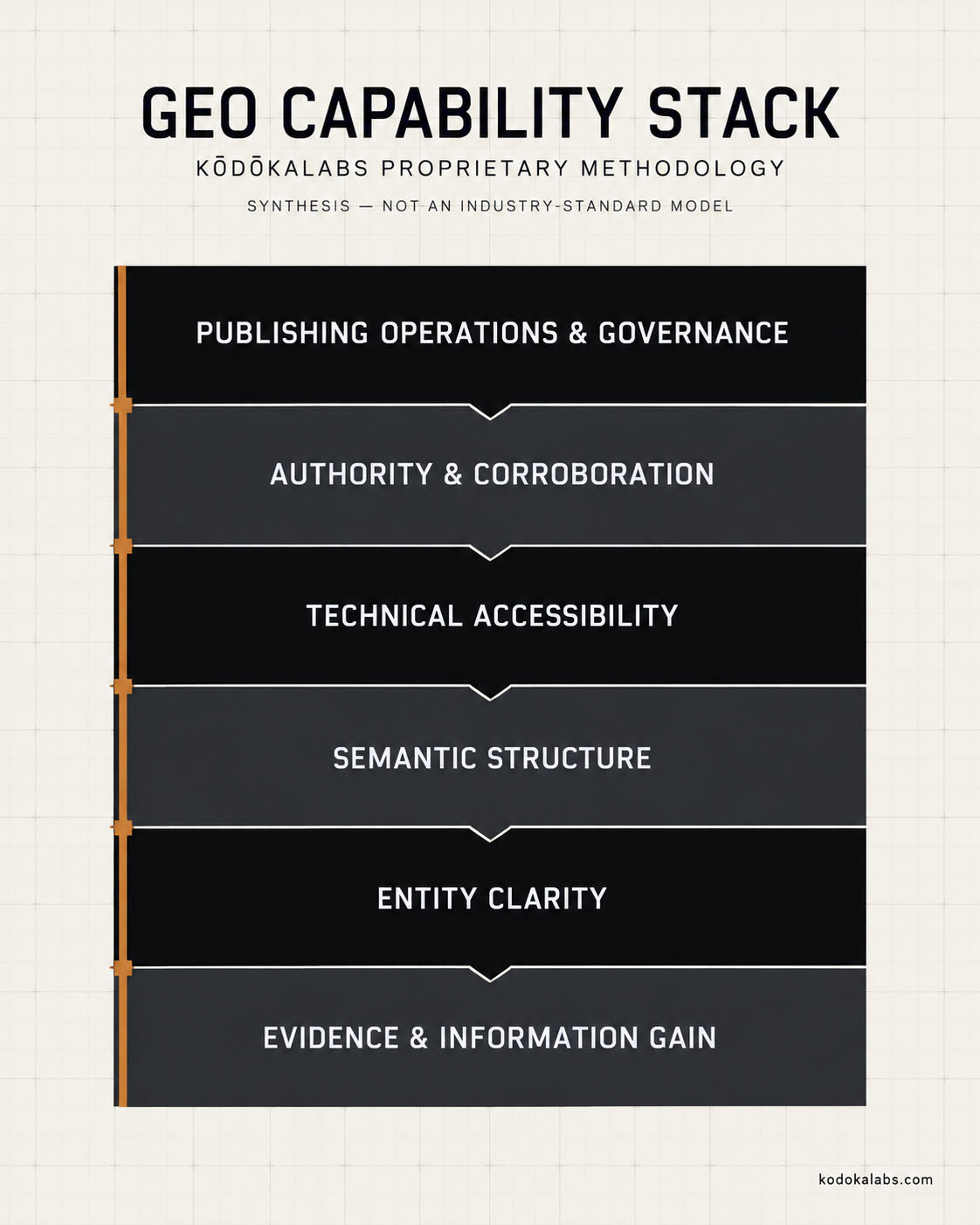
Earning inclusion in generated answers is not the result of a single tactic. It is the output of several connected capabilities working together, each of which has its own dedicated guide in this pillar. kōdōkalabs organizes these into what we call the GEO Capability Stack, our own synthesis of how these capabilities connect, not a claim that any platform has confirmed this exact structure.
The stack has six connected layers. Evidence and information gain: content must contribute something genuinely useful, original, or well-substantiated rather than restating what is already broadly available; see the Information Gain guide. Entity clarity: the organization, its people, products, and claims must be unambiguously identifiable as distinct entities, consistently represented across the web; see the Entity SEO guide. Semantic structure: content must be organized so that its meaning, not just its keywords, is machine-legible, through clear headings, explicit entity mentions, and logical information architecture; see the Semantic Content Architecture guide. Technical accessibility: the relevant crawlers must be able to reach, render, and parse the content, and organizations must make deliberate, documented decisions about which crawlers to allow; see the LLM Optimization and AI Crawler Accessibility guides. Authority and corroboration: claims are strengthened when they are corroborated by independent, credible sources and when the organization has a demonstrable track record on the topic; see the Brand Authority in AI Search guide. Publishing operations and governance: none of the above holds up without a repeatable, reviewed, capability-transferring workflow for producing and maintaining it, which is where Search Intelligence connects into the kōdōkalabs Transformation System and the broader AI Marketing Operating System.
Because organizations cannot directly control whether a platform selects or cites their content, it helps to separate what is genuinely controllable from what is not. The table below applies a control, influence, observe, or unknown classification to the main levers involved in GEO.
| Lever | Classification | Explanation |
|---|---|---|
| Crawler access decisions (robots rules, WAF/CDN configuration) | Control | The organization sets and can verify these directly |
| Content structure, entity clarity, semantic markup | Control | Fully within the organization's editorial and technical process |
| Evidence density and information gain | Control | A direct output of research and editorial quality standards |
| Whether a platform's retrieval system successfully fetches and parses a page | Influence | Controllable inputs raise the likelihood; platform-side rendering and indexing behavior is not directly controllable |
| Whether a given query triggers a generated answer at all | Observe | Determined by the platform based on query type and other factors outside any single organization's control |
| Whether the platform selects, cites, or paraphrases a specific source for a specific answer | Observe | Visible after the fact through sampled query-panel observation; not predictable in advance |
| The complete internal ranking or selection logic of any platform | Unknown | Not disclosed by any major provider as of this review date |
Building The Capability: An Implementation Sequence
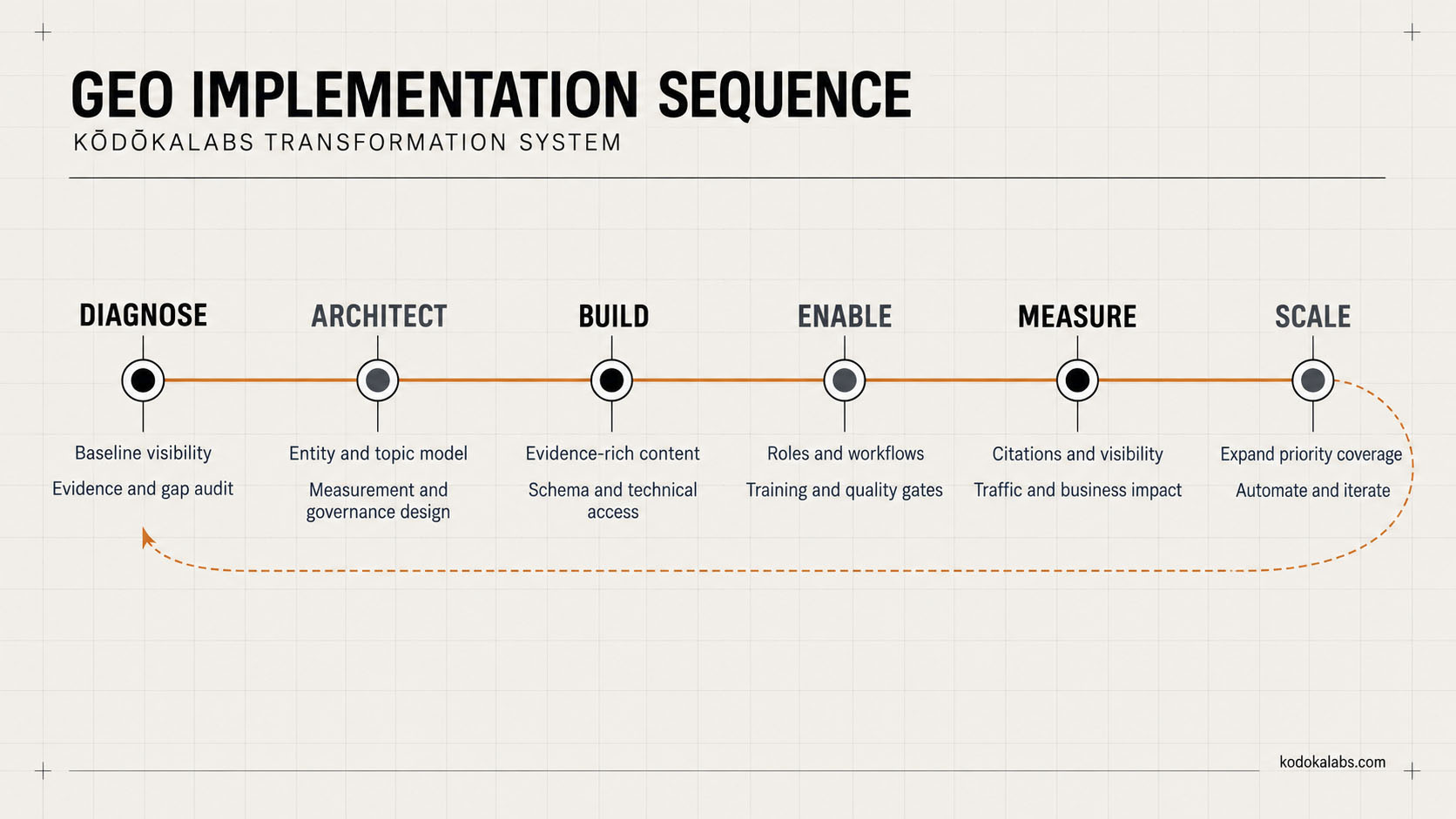
Organizations rarely fail at GEO because they lack tactics. They fail because they attempt GEO tactics without the underlying capability in place. kōdōkalabs sequences GEO capability-building through The kōdōkalabs Transformation System, with Build as the primary phase for this work.
Diagnose. Before any content or technical change, establish a baseline: which of the organization’s pages are currently crawlable by major AI platforms’ documented crawlers, where entity representation is inconsistent or ambiguous across the web, and which topics the organization has genuine evidence and authority to speak to versus where it would be manufacturing claims it cannot support.
Architect. Design the target state: which entities need canonical, disambiguated representation; what semantic and internal-linking architecture will express topical relationships clearly; which crawler-access policy the organization will adopt and why; and which claims require an evidence file before they can be published at all.
Build. This is where GEO work concentrates. Structure and publish content against the architecture from the prior phase. Implement entity markup and internal linking. Configure crawler access deliberately rather than by default. Build the evidence and claim-register discipline described in this pillar’s shared production standard, so that every substantive claim can be traced to a source.
Enable. Capability transfer matters here as much as in any other domain kōdōkalabs works in. Editorial and technical teams need to own the entity registry, the claim register, and the crawler-access policy going forward, not depend permanently on an external vendor to maintain them.
Measure. Establish the tracking approach described in the Search and AI Visibility Measurement guide: a defensible, repeatable method for observing citation presence, mention accuracy, and referral traffic where trackable, understanding that any single measurement method captures a sample, not a census.
Scale. Extend the capability across the content library deliberately, prioritized by topic authority and business value, rather than attempting a wholesale rewrite. Revisit crawler-access and entity decisions as platforms change their documented behavior; time-sensitive platform claims require a recheck immediately before any related content is republished.
Failure Patterns And Limitations
A handful of failure patterns recur across organizations attempting GEO without the capability described above. Treating GEO as a checklist of secret tactics rather than a governed capability leads to churn: teams chase rumored ranking factors that no platform has confirmed, then abandon them when results do not appear, without ever having built durable entity or evidence infrastructure. Publishing content optimized for extraction at the expense of human readability, such as unnaturally fragmented “chunks” intended to be scraped, works against Google’s own stated guidance and produces a worse experience for the much larger population of readers who arrive through traditional search or direct navigation. Assuming crawler access equals guaranteed citation ignores every platform’s own documentation, which is explicit that access is necessary but not sufficient. Treating a single platform’s behavior, most often Google AI Overviews, as representative of “AI search” broadly leads to strategies that are miscalibrated for the meaningfully different retrieval and citation behavior of ChatGPT, Perplexity, and Copilot.
There are also structural limitations to acknowledge honestly. No organization can guarantee inclusion in a generated answer, and any vendor claiming otherwise should be treated with skepticism. Measurement of generated-answer visibility is inherently sampled, not exhaustive, because no platform provides organizations with a complete log of every generated answer in which they might have appeared. Platform behavior changes without notice, meaning any point-in-time observation, including the sources cited in this guide, has a shelf life and requires periodic rechecking.
Measurement And The Next Decision
GEO progress should be measured as a complement to, not a replacement for, traditional search metrics. At minimum, organizations should track citation and mention presence across a defined query panel, sampled at a defensible cadence, representation accuracy when the organization is mentioned or cited, referral traffic where platforms provide trackable links or UTM tagging, and the underlying capability indicators, such as the proportion of priority content meeting the entity-clarity and evidence-density standards described in this guide, that predict future visibility even before citation data is available.
No single metric proves GEO’s return on investment in isolation, and any measurement program should be built with the same evidentiary discipline this guide applies to claims about platform behavior: a defined method, a stated sample, and honest limitations. The Search and AI Visibility Measurement guide sets out the full model; the practitioner-level tracking method is covered separately in Measuring AI Search Visibility and Citation Tracking.
The next decision for most organizations reading this guide is not which GEO tactic to try first. It is whether the underlying Search Intelligence capability, entity clarity, semantic structure, technical access, evidence discipline, and governed publishing, already exists, or needs to be built as part of a broader AI Marketing Operating System. An Executive AI Marketing Assessment is the fastest way to get a grounded answer to that question rather than guessing.
Frequently Asked Questions
Does GEO replace SEO?
No. AI-mediated discovery systems are built substantially on the same crawling, indexing, and content-understanding infrastructure as traditional search. Foundational SEO work remains necessary; GEO adds entity, evidence, and platform-specific access considerations on top of it, it does not substitute for it.
Can kōdōkalabs guarantee our content will be cited by ChatGPT or AI Overviews?
No, and any vendor that makes this promise is claiming control over factors that platforms themselves classify as unpredictable. What can be built and measured is the underlying capability that makes citation more likely over time.
Is there a published list of AI ranking factors we should optimize for?
No major platform has published a complete ranking or selection methodology for generated answers. Claims to the contrary should be treated as unverified inference, not documented fact. This guide separates what platforms have stated from what is reasonable practitioner interpretation.
Do we need to block or allow every AI crawler?
That is a deliberate policy decision, not a default. It depends on the organization's content strategy, competitive posture, and risk tolerance, and should be made explicitly rather than left to whatever a CMS or CDN ships with by default. See the AI Crawler Accessibility and Technical GEO guide for the decision framework.
How is GEO different from AI Overviews optimization specifically?
AI Overviews is one platform's specific generated-answer feature. GEO is the broader discipline that applies across AI Overviews, ChatGPT, Perplexity, Copilot, and future systems. The AI Overviews Strategy guide covers platform-specific considerations; this guide covers the category.
What does "zero-click" mean in this context, and should we be worried about it?
Zero-click describes a search or query that a user's question is answered without a click to any source. It is a real and growing pattern in some query categories, not a reason to stop investing in discoverability; it is a reason to also measure brand impression, representation accuracy, and downstream effects beyond click-through alone.
Where should we start if we have not done any GEO work yet?
With a diagnosis, not a tactic: understand current crawler accessibility, entity consistency, and evidence quality before making technical or content changes. Start with an Executive AI Marketing Assessment to establish that baseline in the context of your full search and content system, not in isolation.
Contextual Solution Pathways
Ready to move from understanding GEO to building it as a governed capability? The AI Marketing Operating System is where kōdōkalabs implements Search Intelligence as part of a complete, governed AI marketing system, connecting workflow, entities, evidence, and measurement rather than treating GEO as an isolated project.