
The
kōdōkalabs
AI Marketing Transformation
Intelligence Hub
AI Marketing Transformation is the redesign of a marketing organization’s workflows, governance, technology, and measurement to operate AI as core infrastructure rather than a set of disconnected tools. It is distinct from simply “using AI in marketing” — an organization can use AI tools extensively and still not have undergone transformation, if that usage hasn’t been paired with documented workflows, defined governance, and a measurable capability baseline. This guide defines the category in full: what it is, how it developed, what’s changed in the industry to make it necessary, the frameworks that structure it, and a practical roadmap for pursuing it.
Definition
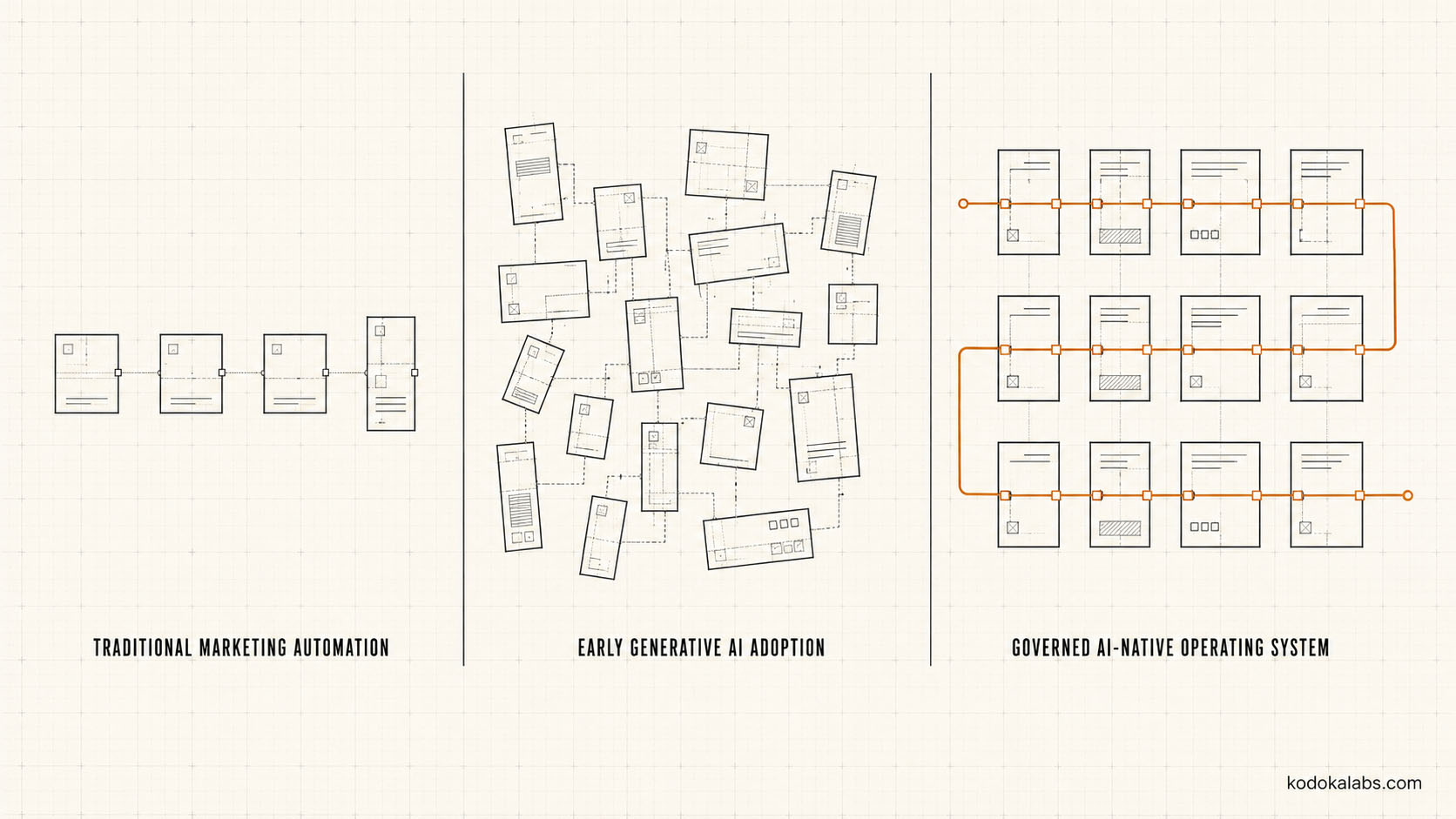
AI marketing transformation is the process of redesigning a marketing organization’s operating model — its workflows, governance structure, technology stack, knowledge management, and measurement systems — so that AI is embedded as governed infrastructure rather than adopted piecemeal by individuals and teams without coordination. It has four defining characteristics that distinguish it from ordinary tool adoption:
- Documented workflows, not tribal knowledge — how work moves from brief to published, reviewed output is written down, not held in individual people’s heads.
- Defined governance, not informal approval — what AI can publish unsupervised versus what requires human review is explicit, not decided ad hoc by whoever happens to be involved.
- A shared knowledge base, not scattered institutional memory — brand guidelines, prior research, and campaign learnings are captured centrally and reused, rather than rebuilt from scratch by each new hire or new tool.
- Measurable capability, not vanity metrics — progress is tracked against a defined maturity baseline, not just channel-level output metrics that say nothing about organizational capability.
An organization that has genuinely undergone AI marketing transformation can absorb a new AI capability in days, because the surrounding system already knows how to evaluate, govern, and integrate it. An organization that has only adopted AI tools individually has to relitigate quality standards and approval processes every time something new shows up — which is the single clearest behavioral signal separating the two.
Latest AI Marketing Transformation Content






Related Terms, And How This Category Differs From Them
Several adjacent terms are frequently used interchangeably with AI marketing transformation, though each describes something narrower:
Marketing automation refers to software-driven execution of repetitive marketing tasks — email sequences, lead scoring, campaign triggers — a category that predates generative AI by well over a decade and typically doesn’t involve AI-generated content or reasoning at all.
AI-powered marketing or AI-first marketing typically describes an organization’s general orientation toward using AI tools, without necessarily implying the documented workflows, governance, and measurement infrastructure that distinguish transformation from tool adoption, as described above.
Marketing technology (martech) modernization refers to upgrading the technology stack itself — new platforms, new integrations — which may be a component of transformation but isn’t sufficient on its own, since new technology without redesigned workflows and governance tends to produce the same fragmentation problems using newer tools.
Digital transformation is the broader, organization-wide category covering technology adoption across every business function, of which AI marketing transformation is a marketing-specific subset requiring its own frameworks for content governance, workflow design, and search strategy.
Understanding these distinctions matters practically: a vendor or consultant offering “marketing automation” or “martech modernization” is addressing a narrower problem than full AI marketing transformation, even if the marketing language sounds similar.
How AI marketing transformation differs from AI tool adoption
AI Tool Adoption vs. AI Marketing Transformation
| Dimension | Tool Adoption | Marketing Transformation |
|---|---|---|
| Scope | individual tools, individual users | organization-wide operating model |
| Documentation | informal or absent | workflows, governance, and knowledge documented |
| Governance | ad hoc, inconsistent | defined AI Governance Matrix with clear approval paths |
| Measurement | tool usage metrics | maturity score across seven dimensions, tracked over time |
| Durability | dependent on specific individuals | survives team turnover, documented and transferable |
| Onboarding a new AI capability | weeks of ad hoc evaluation | days, evaluated against existing framework |
History: How Marketing Got Here
Marketing’s relationship with AI didn’t begin with generative AI tools becoming mainstream. Predictive analytics, programmatic ad buying, and marketing automation platforms have used machine learning underpinnings for well over a decade, largely operating behind the scenes in targeting and optimization. What changed with the arrival of large language models was that AI became a visible, direct participant in content creation, research, and strategic reasoning — tasks previously considered exclusively human, and tasks at the center of how marketing organizations are staffed and structured.
This shift happened faster than most organizational structures could adapt. In the span of a few years, individual marketers gained access to tools capable of drafting content, synthesizing research, and generating creative variations at a pace that outstripped the workflows, governance structures, and quality-control processes built for a pre-AI production model. Most organizations responded the way organizations typically respond to fast-moving technology: individual adoption first, organizational redesign much later, if at all. That gap — between what individuals can now do with AI tools and what the organization has structurally adapted to support and govern — is the specific gap AI marketing transformation closes.
A parallel shift has been happening in search. Traditional search engines built their ranking systems around backlinks, keyword relevance, and page authority signals refined over two decades. AI answer engines — tools like ChatGPT, Perplexity, Gemini, and Copilot — synthesize a single answer from multiple sources rather than returning a ranked list of links, and they select sources based on different signals: entity clarity, structured data, direct-answer formatting, and information density. A marketing organization optimized purely for traditional search rankings can find itself invisible in AI-generated answers, even while maintaining strong traditional SEO performance. This dual-search reality is one of the industry changes described in more detail below, and it’s a major reason transformation, not incremental optimization, has become necessary.
Industry Changes Driving Transformation Now
Several forces are converging to make organizational redesign urgent rather than optional:
Search is splitting into two distinct disciplines. Traditional SEO and Generative Engine Optimization (GEO) reward different things — one prioritizes backlink authority and keyword targeting, the other prioritizes entity clarity, citation-worthy data density, and structured, extractable formatting. A page can perform strongly in traditional rankings while remaining effectively invisible to AI answer engines, because the two systems evaluate fundamentally different signals. Organizations need competence in both simultaneously, covered in depth on the [Search Intelligence pillar](/intelligence-hub/search-intelligence).
The economics of content production have shifted. When AI-assisted workflows can produce what previously required a larger team, the constraint moves from execution capacity to system quality — how good the governance, knowledge base, and quality control are, not how many people are available to produce output. Organizations still staffed and budgeted for the old constraint are misallocating resources relative to where the actual bottleneck now sits, often paying for headcount to solve a problem that’s actually a systems problem.
Governance has become a genuine business risk, not a hypothetical one. As AI-assisted output volume scales, the absence of a defined approval structure stops being a minor inefficiency and becomes real brand and compliance exposure — inconsistent claims, off-brand messaging, or factually unreliable content published without adequate review. Regulatory attention to AI-generated content is also increasing across multiple industries, making informal governance a growing legal exposure, not just a quality-consistency issue.
Talent expectations are shifting. Marketers increasingly expect to work with, not around, AI tools as part of their daily practice, and organizations without a coherent AI operating model struggle to retain talent who’ve developed strong habits at better-structured organizations. Candidates evaluating a marketing role increasingly ask about AI tooling and governance during interviews, treating it as a proxy for how well-run the organization is generally.
Competitive pressure is compounding. Organizations that have already undergone transformation are producing higher volumes of higher-quality, more citable content at lower marginal cost — a gap that widens each quarter it goes unaddressed, because compounding knowledge bases and refined workflows create real, growing distance rather than a fixed one-time advantage. This compounding effect is one of the most underappreciated aspects of the shift: the organizations furthest along aren’t just ahead, they’re accelerating relative to organizations that haven’t started.
Buyer research behavior has changed. A growing share of B2B research now happens through conversational AI tools before a prospect ever visits a company’s website directly, meaning visibility inside AI-generated answers has become a real pipeline factor, not just an SEO nice-to-have — a dynamic explored further on the [Revenue Systems pillar](/intelligence-hub/revenue-systems).
Frameworks
kōdōkalabs approaches AI marketing transformation through a small set of named frameworks, each addressing a specific part of the transformation problem:
- The kōdōkalabs Transformation System — the master six-phase methodology (Diagnose, Architect, Build, Enable, Measure, Scale) that structures how transformation actually gets executed, covered in full on the Framework page.
- AI Marketing Maturity Model — the diagnostic standard used to score an organization’s current transformation maturity across seven dimensions: technology, workflows, content, search, governance, team capability, and measurement.
- The AI Marketing Operating System — the target operating model transformation builds toward: documented workflows, a shared knowledge base, governed automation, and a content engine, explained in full on the [AI Marketing Operating Systems pillar](/intelligence-hub/ai-marketing-operating-systems).
- The AI Governance Matrix — the governance structure defining what AI can publish unsupervised versus what requires human review, by content category and risk level.
- Human + AI Execution Model — the task-level division of labor defining, within any given workflow, what AI executes and what requires human judgment.
- Capability Transfer Framework — the model governing how documentation, training, and governance ownership move from an outside partner to an internal team on a defined timeline, rather than creating indefinite dependency.
Framework Quick Reference
| Framework | What It Addresses | Where It’s Used |
|---|---|---|
| The kōdōkalabs Transformation System | Structures the complete AI marketing transformation through six phases: Diagnose, Architect, Build, Enable, Measure, and Scale. It connects strategic assessment, operating-model design, implementation, capability building, performance management, and continuous improvement. | Used across all four solutions as the master delivery methodology: Executive AI Marketing Assessment, AI Marketing Operating System, Fractional AI Growth Director, and AI Capability Academy. |
| AI Marketing Maturity Model | Assesses an organization’s current AI marketing maturity across seven dimensions: technology, workflows, content, search, governance, team capability, and measurement. It identifies capability gaps, transformation priorities, and the appropriate starting point. | Primarily used in the Executive AI Marketing Assessment during the Diagnose phase. Its findings inform priorities for the Architect phase and provide a baseline for later measurement. |
| The AI Marketing Operating System | Defines the target operating model for AI-enabled marketing: documented workflows, a shared knowledge base, governed automation, clear ownership, and a scalable content engine. | Primarily designed and implemented through the AI Marketing Operating System solution during the Architect and Build phases. It is further operationalized through the Enable, Measure, and Scale phases. |
| The AI Governance Matrix | Defines which AI-supported activities may run automatically, which require human review, and which should remain human-controlled. Decisions are organized by content category, business impact, data sensitivity, and risk level. | Used within the AI Marketing Operating System, Fractional AI Growth Director, and AI Capability Academy solutions. It is established during Architect, implemented during Build, embedded through Enable, and reviewed during Measure and Scale. |
| Human + AI Execution Model | Assigns tasks within each workflow according to whether they require AI execution, human judgment, or structured collaboration between both. It clarifies responsibilities, review points, and escalation requirements. | Used when designing and implementing workflows through the AI Marketing Operating System and Fractional AI Growth Director solutions. It is defined during Architect, implemented during Build, and taught during Enable through the AI Capability Academy. |
| Capability Transfer Framework | Governs how documentation, practical knowledge, training, workflow ownership, and governance responsibility move from an external transformation partner to the internal team on a defined timeline. | Used primarily within the AI Capability Academy and Fractional AI Growth Director solutions. It begins during Architect, is documented during Build, delivered through Enable, and validated during Measure before ownership is expanded in Scale. |
A Practical Roadmap
-
1Establish a baseline.Score current maturity across technology, workflows, content, search, governance, team capability, and measurement before making any tool or process decisions. Skipping this step is the most common reason transformation initiatives stall — decisions get made against assumptions instead of evidence, and assumptions about maturity tend to be optimistic exactly where the gaps are largest, particularly around governance.
-
2Design the target operating model.Define workflows, governance structure, roles, and technology stack mapped to the organization’s specific goals and gaps, not a generic template borrowed from a different organization’s context. This step typically produces more than one viable design option, since real tradeoffs exist between rollout speed and scope breadth — the right choice depends on organizational risk tolerance and resourcing more than on a single “correct” answer.
-
3Implement iteratively.Build workflows one at a time, starting with the highest-priority content or campaign type, producing real output and reviewing it against defined quality standards before expanding further. Iterative implementation keeps the organization producing usable output throughout the build process, rather than pausing operations for a big-bang cutover.
-
4Train and certify the internal team.Transfer ownership of documentation, training, and governance to the internal team on a defined timeline, with certification tied to demonstrated, independent workflow ownership rather than passive training attendance. Training that starts before implementation is fully finished, so team members can pilot workflows they’ll eventually own, produces meaningfully better long-term adoption than training delivered only after the fact.
-
5Measure continuously.Track execution velocity, governance maturity, content and search performance, internal capability, and cost per output against the original baseline, on a recurring cadence. Measurement that isn’t tied back to a defined baseline tends to drift toward reporting activity rather than capability, which undermines the ability to demonstrate real progress to leadership or a board.
-
6Scale deliberately.Extend what’s working to new channels, teams, or markets, re-running a lightweight version of the baseline assessment for the new scope rather than assuming the existing system transfers automatically. A workflow or governance structure calibrated for one product line or market doesn’t necessarily transfer cleanly to a new one without adjustment.
Who Leads Transformation Inside An Organization
Ownership of AI marketing transformation varies by organization, but it consistently requires someone with both strategic authority and hands-on operational visibility — a combination that doesn’t always sit with a single existing role. In organizations with a CMO, transformation ownership typically sits there, provided the CMO has (or builds) the specific AI-governance and workflow-design fluency the role requires. In organizations without a dedicated marketing executive, or where the existing executive doesn’t have bandwidth for a structured transformation initiative, an external role such as a Fractional AI Growth Director fills the gap without requiring a full-time executive search.
Regardless of who holds ultimate ownership, successful transformation efforts consistently involve three groups: an executive sponsor with the authority to make governance and resourcing decisions, a marketing operations lead who owns day-to-day workflow design and documentation, and the broader marketing team whose hands-on adoption and certification (per the Enable phase) ultimately determines whether the new operating model sticks. Transformation efforts that rely on only one of these three groups — an enthusiastic executive with no operational follow-through, or a marketing ops lead without executive backing to enforce governance — are disproportionately represented among the stalled efforts described in the failure patterns above.
Common Failure Patterns
A small number of failure patterns account for most stalled or abandoned transformation efforts:
- Skipping the baseline. Organizations that jump straight to purchasing tools or restructuring teams without a documented maturity baseline can rarely demonstrate real progress later, because there’s nothing to measure against.
- Treating governance as optional. Governance is the dimension most frequently left undefined, and the one most likely to create real business risk once AI-assisted output scales past what informal oversight can track.
- Relying on individual champions instead of documented systems. Transformation efforts led entirely by one enthusiastic individual tend to stall the moment that person’s attention shifts elsewhere, because the knowledge and momentum never got captured in transferable, documented form.
- Confusing tool adoption with transformation. As covered above, high individual tool usage is a weak signal of organizational transformation maturity, and mistaking one for the other leads leadership to overestimate progress.
- No defined capability-transfer timeline. Organizations that bring in outside help without a defined handoff plan often remain dependent indefinitely, never building the internal capability that makes transformation durable.
How To Measure Transformation Progress
Transformation progress should be tracked across the same five business-outcome dimensions used throughout The kōdō Transformation System: execution velocity (time from brief to published, reviewed output), governance maturity (percentage of AI-assisted output following a defined approval path), content and search performance (traditional SEO visibility alongside GEO/LLM citation frequency), internal capability (team members certified on documented workflows), and cost per output (cost to produce a unit of qualified marketing output).
Re-scoring the AI Marketing Maturity Model on a recurring basis — typically every six to twelve months — provides the clearest longitudinal view, since it uses the same standard each time rather than switching measurement approaches as circumstances change.
Frequently Asked Questions (FAQ)
What is AI marketing transformation?
AI marketing transformation is the redesign of a marketing organization's workflows, governance, technology, and measurement so AI operates as governed infrastructure rather than a set of disconnected individual tools. It's an organizational change, not a technology purchase.
How is this different from digital transformation generally?
Digital transformation is a broad, organization-wide category covering technology adoption across every business function. AI marketing transformation is specific to how marketing organizations redesign their operating model around AI — narrower in scope, but requiring marketing-specific frameworks for workflow design, content governance, and search strategy that a generic digital-transformation approach doesn't address.
How long does AI marketing transformation typically take?
Using The kōdōkalabs Transformation System, most organizations move through Diagnose and Architect within one to two months, with Build, Enable, Measure, and Scale unfolding over two to four quarters depending on organizational size and starting maturity. Transformation itself, per the Scale phase, is treated as continuous rather than something with a fixed end date.
Can a small marketing team pursue this, or is it only for large organizations?
The same six-phase sequence applies regardless of team size — a five-to-fifteen-person team typically moves through Diagnose and Architect faster, with proportionally more emphasis needed on Enable, since there's less redundancy if only one or two people are trained on a given workflow.
Do we need outside help, or can this be done entirely internally?
It's possible to run this process internally, though internal efforts most commonly stall due to the failure patterns described above — particularly skipping the baseline and lacking a defined capability-transfer plan. Outside support, such as an Executive AI Marketing Assessment, is most valuable for establishing an objective baseline and avoiding the common failure patterns, even for organizations that plan to execute most of the work internally afterward.
Is AI marketing transformation a one-time project or an ongoing process?
Ongoing. The Scale phase of The kōdōkalabs Transformation System explicitly loops back into Diagnose, treating transformation as a continuous cycle rather than a project with a defined end date — new capability gaps, new AI developments, and organizational growth all create new cycles of the same sequence.
What roles typically need to be involved?
At minimum, an executive sponsor with governance and resourcing authority, a marketing operations lead who owns workflow design and documentation, and the marketing team members who will directly use and eventually own the new workflows. Larger organizations often also involve IT/security (for technology and data governance) and sales leadership (for pipeline-impact context during the Diagnose phase).
How does this relate to Generative Engine Optimization (GEO)?
GEO is one specific capability required for successful transformation, covering how content should be structured and optimized to be cited by AI answer engines rather than only ranked by traditional search engines. It's a component of the Build phase and is covered in depth on the Search Intelligence pillar, but transformation encompasses considerably more than search strategy alone — governance, workflow design, and measurement are equally central.
What's the biggest misconception about AI marketing transformation?
That it's primarily a technology decision. The organizations that succeed treat it as an operating-model and governance redesign that happens to involve new technology, not a technology rollout that happens to touch the organization. Leading with tool selection before workflow and governance design is one of the most common ways transformation efforts underperform their potential.
The Latest News and Updates
From the kōdōkalabs
Intelligence Hub



Book An
Assessment
The fastest way to find out where your marketing organization stands is a structured assessment, not a sales call.
In a 90-minute Executive AI Marketing Assessment, we evaluate current maturity, technology, processes, team, content, search, and governance against the AI Marketing Maturity Model, and leave you with a prioritized roadmap — whether or not you engage kōdōkalabs further.